Base’s Cobalt upgrade adds another rule to affect token balances
Story summary
Scheduled for September 30 at 18:00 UTC, Cobalt would let B20 issuers opt into seizure policies independent of ordinary transfer restrictions. The post Base’s Cobalt upgrade adds another rule to affect token balances appeared first on CryptoSlate.
📌 Key Highlights & Takeaways
- Scheduled for September 30 at 18:00 UTC, Cobalt would let B20 issuers opt into seizure policies independent of ordinary transfer restrictions.
- The post Base’s Cobalt upgrade adds another rule to affect token balances appeared first on CryptoSlate.
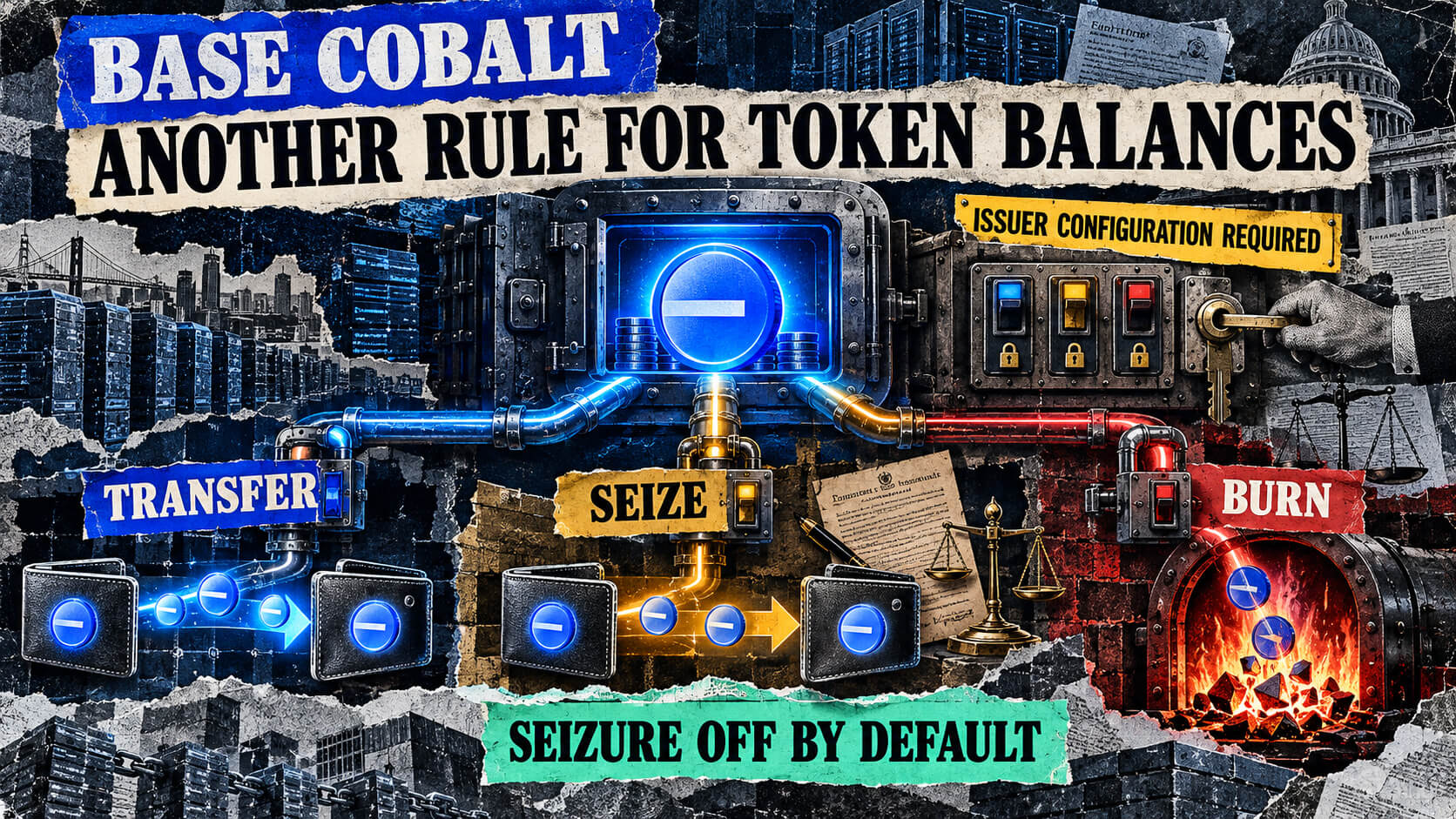
Base’s Cobalt upgrade, scheduled for mainnet Sept. 30 at 18:00 UTC, will let issuers of B20 tokens configure balance seizures separately from ordinary transfer restrictions. For a token that enables the feature, a holder could remain free to transfer while still being eligible for administrative reassignment.
B20 is Base’s native ERC-20-compatible token standard , offered in Asset and Stablecoin variants. It already gives administrators control over roles and policies governing balance movements, and now it will also govern the administrative powers over those balances.
Role assignments identify who can exercise a particular power, while policy settings determine which accounts an operation can affect. Changing a token’s rules and executing a balance operation involve distinct permission checks.
The new administrative operation , called seizeWithMemo , moves a specified amount from a holder to another address. It preserves total supply and skips ordinary transfer policies and holder allowances.
An issuer must configure which accounts lose their exemption before the function can take their tokens. The setting, SEIZE_EXEMPT_POLICY , exempts everyone when left unset. Configuring eligibility alone is insufficient: execution requires SEIZE_ROLE , an unpaused seizure function, a permitted recipient, and sufficient balance.
A separate recipient policy determines where the seized tokens can go, and leaving that policy unset allows any otherwise valid destination. The holder’s ability to make an ordinary transfer does not answer either seizure-policy question.
B20’s existing transfer policies check the sender and receiver, plus the executor for certain transfers on another account’s behalf. Administrators can update those policies. Approving a spender does not remove the checks on the eventual transfer, but those ordinary transfer permissions are distinct from Cobalt’s seizure rules.
B20 also already has burnBlocked , which lets an authorized caller destroy tokens held by an account denied by the transfer sender policy . Cobalt marks that function deprecated but keeps it callable with its existing behavior.
Crypto Profit & Yield Calculator
Simulate trading returns, staking APY, and crypto gains with real-time fee modeling.
Source: CryptoSlate.
Read the full story at the original source ↗
For questions: mrsmithcons@gmail.com.
💎 On-Chain Wallet Tracking & Breakout Targets
Direct wallet address monitoring, smart money flows, and liquidity depth.
⚡ Track Whale Wallets Now ➔More from CryptoAce VIP

 ⚡ LiveCoin Bet
3 Token Unlocks to Watch in the Second Week of September 2026
The crypto market will welcome tokens worth roughly $325.6 million in the second week of September 2026. Major...
 🎁 Get Rich Free
Variational plant die Einführung des VAR-Tokens mit 32 % Airdrop im vierten Quartal 2026
Aktuelle Berichterstattung von Crypto Briefing: Variational plant die Einführung von VAR-Token mit 32 % Airdro...
 🪙 FreeFortune Crypto
Prompt Engineering Optimization & Latency Minimization for Token Farming
Comprehensive 2026 research dossier and telemetry report on Prompt Engineering Optimization & Latency Minimiza...
Another January 6th? Supreme Court, Midterms & Trump Stroke Rumors
FOR ENTERTAINMENT PURPOSES ONLY NESS : Self book here: Single Question reading: $44.44 You can reach her at As...