Drift hack recovery opened near one cent per dollar lost
Story summary
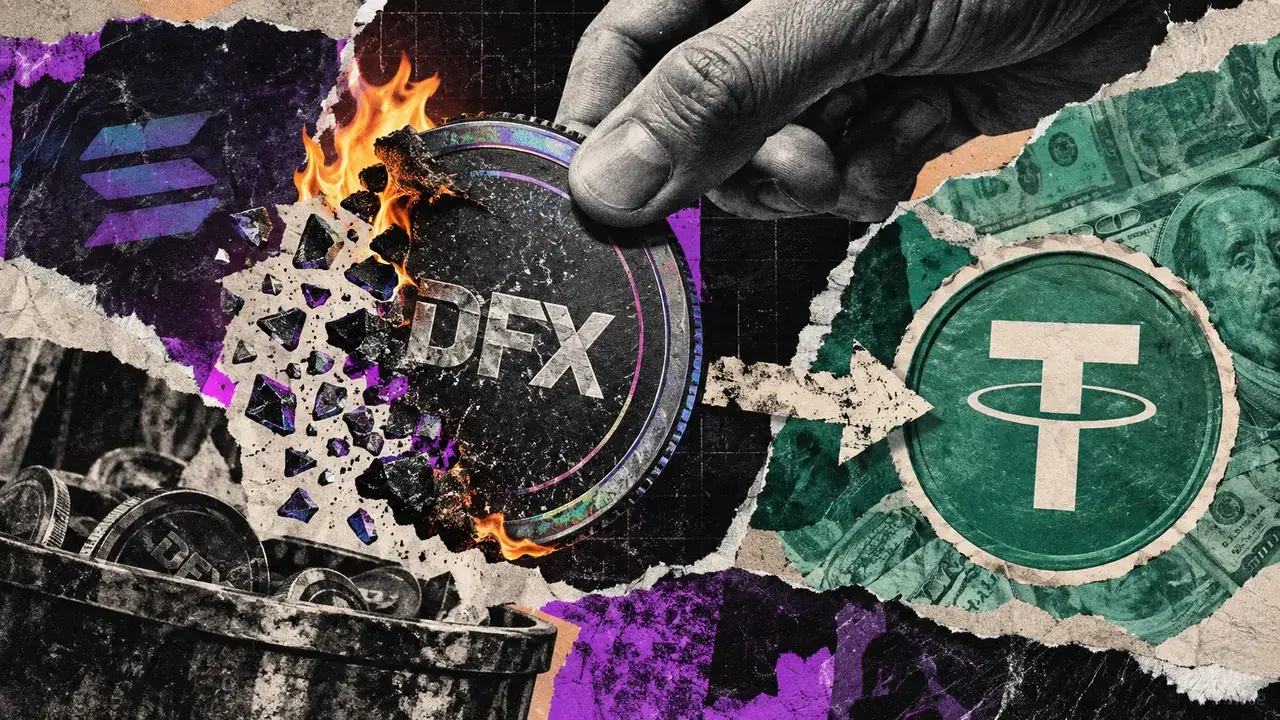
Drift's October 1 launch quote valued DFX near one cent per USDT lost, while redemption ends future pool participation for the tokens burned. The post Drift hack recovery opened near one cent per dollar lost appeared first on CryptoSlate.
📌 Key Highlights & Takeaways
- Drift's October 1 launch quote valued DFX near one cent per USDT lost, while redemption ends future pool participation for the tokens burned.
- The post Drift hack recovery opened near one cent per dollar lost appeared first on CryptoSlate.
Drift Protocol opened claims and redemptions for its DFX recovery token on Oct. 1, giving victims of its April exploit a way to receive the USDT stablecoin from the Recovery Pool. The exit has a permanent tradeoff: redeemed tokens are burned and no longer share in future deposits.
In its launch announcement , Drift described a payout of about 0.0104 USDT per DFX from a pool holding roughly 3.1 million USDT. Because victims receive one DFX for each USDT of verified loss, that launch rate represented about 1.04% of the corresponding loss. Those are Oct. 1 figures; a redemption pays the rate quoted when the transaction is made.
DFX is a transferable token on Solana, separate from the DRIFT governance token. Drift sets its fixed allocation at 299,500,810.998 DFX, corresponding to nearly 299.5 million USDT of verified losses. Outstanding supply falls as tokens are burned.
The USDT payment and DFX burn happen in one transaction: either both succeed or neither does. Drift says completed redemptions are final. If a holder redeems only part of their DFX, the tokens they keep continue participating in the pool.
Future deposits are divided among the DFX that remain. Cashing out therefore locks in the quoted recovery amount for the tokens burned, while giving up their share of later revenue or recovered funds.
Selling DFX on a secondary market such as Raydium is a different transaction. It transfers the tokens to another holder rather than redeeming them against the pool. Holding preserves participation in future deposits, whose size and timing remain uncertain.
The recovery dashboard defines the redemption price as the pool balance divided by outstanding DFX. Under Drift's stated design, redemption removes cash and burns tokens in the same proportion, leaving that ratio unchanged. New deposits raise the amount redeemable per remaining token.
The support plan announced in April 2026 was restated in Drift's Oct. 1 update: up to 127.5 million USDT from Tether for relaunch and user recovery, plus up to 20 million USDT from strategic partners for recovery. Those commitment ceilings do not measure cash already available for redemption.
Crypto Profit & Yield Calculator
Simulate trading returns, staking APY, and crypto gains with real-time fee modeling.
Source: CryptoSlate.
Read the full story at the original source ↗
For questions: mrsmithcons@gmail.com.
❓ Frequently Asked Questions (Whale Tracking Briefing)
What on-chain catalyst or market signal triggered this Whale Tracking movement?
Institutional on-chain telemetry, cold storage accumulation, and derivative funding rates indicate spot liquidity positioning that underpins this Whale Tracking development.
How should investors interpret current liquidity pools and network hash activity?
Derivative funding remains balanced and exchange reserves continue trending downward, mitigating systemic liquidation cascades and strengthening the underlying structural floor.
Where are the critical technical support and invalidation levels?
Anchored volume-weighted average price (VWAP) benchmarks and high-density order book clusters near prior consolidation ranges serve as key risk management thresholds.
💎 On-Chain Wallet Tracking & Breakout Targets
Direct wallet address monitoring, smart money flows, and liquidity depth.
⚡ Track Whale Wallets Now ➔More from CryptoAce VIP


 💎 Try2Rich
My Financial Recovery Journey: Why I Started a GoFundMe
An open, honest look into facing mounting financial distress, moving past the shame of debt, and choosing tran...
 📦 Free2Rich Vault
Every new Googlebook includes nearly $600 in free software perks
Breaking coverage reported by Chrome Unboxed: Every new Googlebook includes nearly $600 in free software perks...
 🪙 FreeFortune Crypto
NEAR Protocol News: Staking Milestone Unlocks Private AI Compute
Breaking coverage: NEAR Protocol News: Staking Milestone Unlocks Private AI Compute. Comprehensive monitoring,...
![Erster Blick: In der neuen Centurion Lounge von Amex in Amsterdam [Von Senior Analyst geprüft.]](https://images.unsplash.com/photo-1534447677768-be436bb09401?w=1200&q=80) 🎉 FreeFortune Rewards
🎉 FreeFortune Rewards
Erster Blick: In der neuen Centurion Lounge von Amex in Amsterdam [Von Senior Analyst geprüft.]
Amex eröffnet eine neue Centurion Lounge am Amsterdamer Flughafen Schiphol mit einer eigenen Kaffeebar, nieder...