Robinhood Chain produzierte während einer etwa 40-minütigen App-Unterbrechung weiterhin Blöcke
Story summary
Neue ganztägige Messungen korrigieren die Blockstopp-Behauptung, während separate Daten einen starken Rückgang des erfolgreichen App-Verkehrs zeigen. Der Beitrag Robinhood Chain produzierte während einer etwa 40-minütigen App-Unterbrechung weiterhin Blöcke und erschien zuerst auf CryptoSlate.
📌 Key Highlights & Takeaways
- Neue ganztägige Messungen korrigieren die Blockstopp-Behauptung, während separate Daten einen starken Rückgang des erfolgreichen App-Verkehrs zeigen.
- Der Beitrag Robinhood Chain produzierte während einer etwa 40-minütigen App-Unterbrechung weiterhin Blöcke und erschien zuerst auf CryptoSlate.
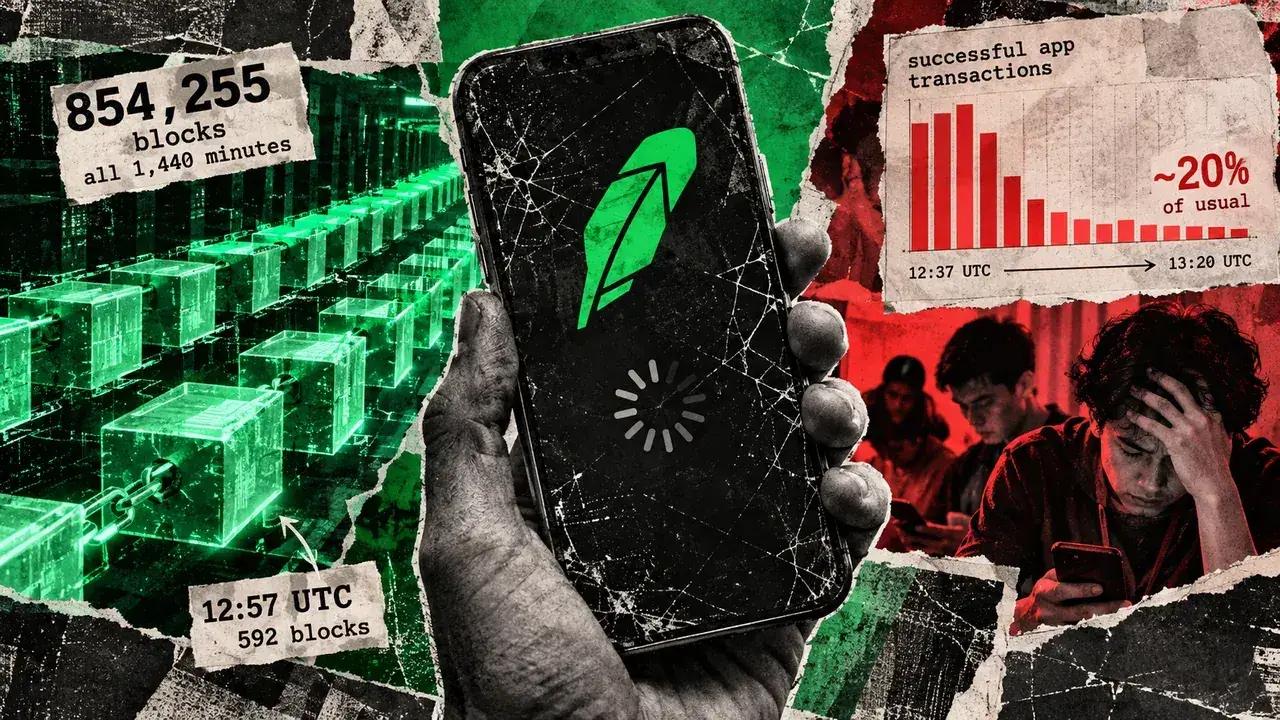
Robinhood Chain, an Ethereum layer-2 network, kept producing blocks throughout its Sept. 4 disruption. A new full-day measurement corrects CryptoSlate's earlier report that block production stopped for at least 14 minutes. Separate public-data analysis found that successful transactions through busy apps fell sharply for about 40 minutes, leaving users with a real disruption despite the continuing blocks.
Glass Hull's Sept. 29 measurement counted 854,255 blocks across all 1,440 minutes of Sept. 4 UTC. The longest gap between consecutive recorded block timestamps was two seconds. In the minute beginning 12:57 UTC, the reported start of the supposed halt, the chain produced 592 blocks.
CryptoSlate's Sept. 5 article said block production had halted for at least 14 minutes. That claim was wrong. Glass Hull measured a different 14-minute total: two separate pauses in posting Robinhood Chain transaction data to Ethereum, from 12:29:47 to 12:38:23 UTC and from 12:42:47 to 12:48:11 UTC. Both ended before 12:57, and neither interrupted the chain's block production. L2BEAT's liveness record lists comparable gaps in Ethereum data submissions. A layer-2 chain can keep making blocks while its separate posting process is delayed.
Walnut's Sept. 23 analysis found successful traffic through busy Robinhood Chain apps fell sharply from about 12:37 to 13:20 UTC. Its median busy app completed about one fifth of its usual successful transactions during the slump. Walnut reads delayed oracle updates and smart-wallet transaction failures as signs that attempted submissions were lost before reaching blocks. Public chain data leave the point of failure unresolved.
QuickNode began investigating increased Robinhood Chain mainnet latency at 13:10 UTC. At 16:20 UTC, the provider warned that users might encounter degraded performance and transactions failing to land while it investigated sequencer-feed connection issues. QuickNode's record covers its own service, while Walnut's roughly 40-minute figure measures successful app traffic.
In a Sept. 4 statement , @arbitrum said the chain had no downtime and direct user transactions had no delays. It also reported a brief performance impact for some providers that rely on the chain's data stream amid many feed subscribers. The statement separates direct submissions from provider services; Walnut's app-traffic measurement and QuickNode's incident show why the distinction matters to users.
Walnut argues that a low batch-poster tip was outbid during an Ethereum fee spike, delaying data posts. Glass Hull leaves the posting gaps' cause unresolved. The public record establishes continuous block production alongside impaired app traffic, while the precise off-chain failure point, whether in a sequencer queue or an RPC layer, and its connection to the posting delays remain open.
The post Robinhood Chain kept producing blocks through a roughly 40-minute app disruption appeared first on CryptoSlate .
Crypto Profit & Yield Calculator
Simulate trading returns, staking APY, and crypto gains with real-time fee modeling.
Source: CryptoSlate.
Read the full story at the original source ↗
For questions: mrsmithcons@gmail.com.
💎 On-Chain Wallet Tracking & Breakout Targets
Direct wallet address monitoring, smart money flows, and liquidity depth.
⚡ Track Whale Wallets Now ➔More from CryptoAce VIP


 📈 1UpTrade Live
Der 1,5-Milliarden-Dollar-Boom der Robinhood Chain zieht Memecoin-Teppichfabriken an
Eine zweite mutmaßliche Memecoin-Teppichfabrik ist auf Robinhood Chain aufgetaucht, da das schnell wachsende N...
 ⚡ LiveCoin Bet
Best Crypto Casinos for September 2026 | Under 5-Minute Cashout Sites Listed
Breaking coverage reported by Muddy River Sports: Best Crypto Casinos for September 2026 | Under 5-Minute Cash...
Touring a $45M Mansion Where Superyachts Pass Every 5 Minutes
Thanks to GoldHaven Resources for sponsoring today's video. You can get their latest presentation here on thei...
 💰 Free2Rich Online
Rebuilding Financial Stability Through Community Support
How collective grassroots generosity and transparent micro-giving empower hardworking individuals to escape pr...