La propuesta de la moneda estable de la Fed haría de la circulación un costo de capital para los emisores supervisados
Story summary
Con mil millones de dólares pendientes sin ingresos no procedentes de reservas, la línea base de riesgo operativo propuesta sería de 20 millones de dólares antes de ajustes. La propuesta posterior a la moneda estable de la Fed haría que la circulación sea un costo de capital para los emisores supervisados apareció por primera vez en CryptoSlate.
📌 Key Highlights & Takeaways
- Con mil millones de dólares pendientes sin ingresos no procedentes de reservas, la línea base de riesgo operativo propuesta sería de 20 millones de dólares antes de ajustes.
- La propuesta posterior a la moneda estable de la Fed haría que la circulación sea un costo de capital para los emisores supervisados apareció por primera vez en CryptoSlate.
A hypothetical payment stablecoin issuer within the Federal Reserve's proposed supervisory scope, with $1 billion in circulation and no revenue from activities outside its reserve assets, would start with a $20 million baseline operational-risk capital charge under the Fed's proposal announced Sept. 24. A separate loss-history adjustment and any other applicable capital charges would still have to be applied. The issuer would also need reserves backing its coins.
The proposal gives the growth of a stablecoin a direct capital consequence: more coins outstanding mean a larger baseline operating-risk charge, even if the issuer earns nothing from custody or other activities. The formula would apply to approved stablecoin-issuing subsidiaries of insured state member banks and to certain qualifying state-chartered issuers that transition to Fed supervision. The Office of the Comptroller of the Currency's pending proposal takes a different route for issuers under its jurisdiction, using a capital amount tailored to each business and a separate pool of liquid assets tied to expenses.
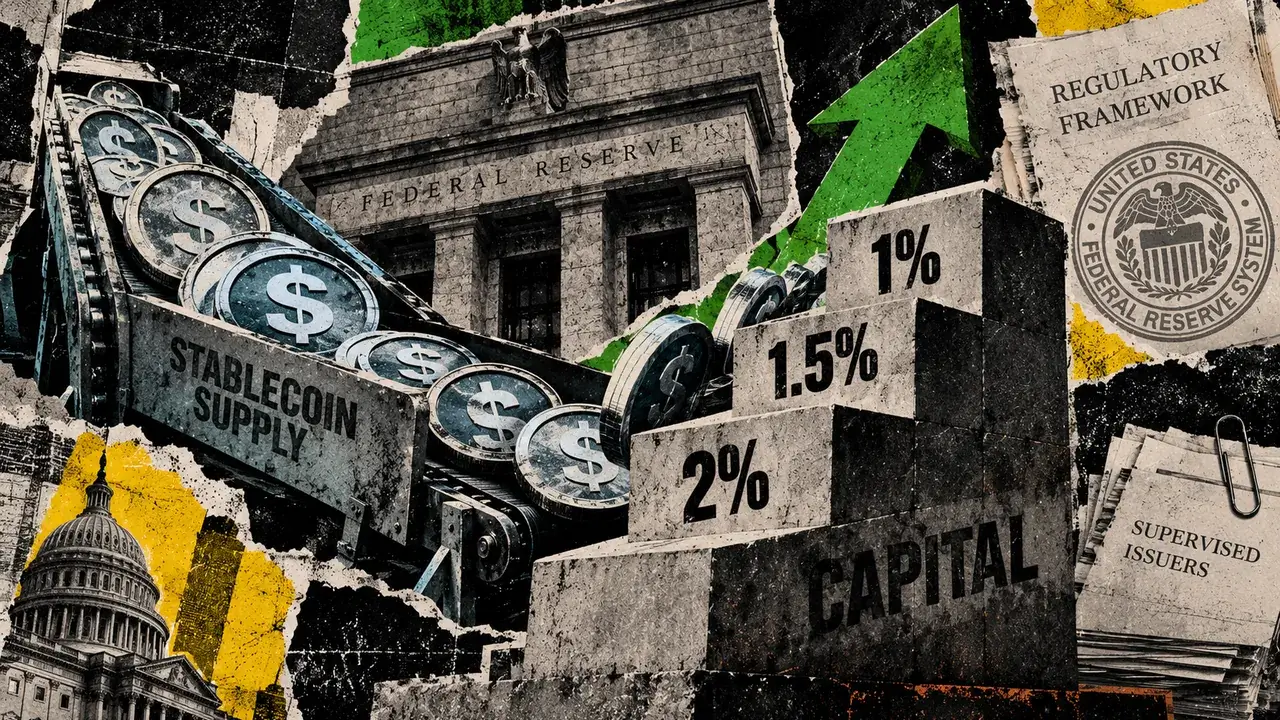
For the first $20 billion of payment stablecoins outstanding, the Fed would calculate the issuance portion of baseline operational-risk capital at 2%. The rate would fall to 1.5% on the next $30 billion and 1% on the amount above $50 billion. These are marginal bands: crossing a threshold would change the rate only on the additional issuance. The Board's memo also adds 25% of the issuer's three-year average annual revenue from non-reserve assets to the baseline.
At $10 billion outstanding with no non-reserve revenue, the baseline issuance portion would be $200 million. This second hypothetical remains entirely in the first band. Both calculations are hypothetical.
The Fed also proposes a loss scalar that can move the operational-risk charge up or down in response to realized losses. An individual issuer's operating-risk charge would also reflect the loss adjustment; its total capital requirement could include other components.
Capital and stablecoin reserves serve different purposes. The Fed would require covered issuers to keep eligible reserve assets with a fair value at least equal to the par value of their outstanding coins. It separately proposes a 2% capital charge on reserve assets that are uninsured deposit claims or undercollateralized reverse repurchase agreements. Those possible credit-risk charges sit apart from the operational-risk calculation. One-to-one reserve assets are a separate requirement from the $20 million baseline capital figure.
The Board memo limits the second category to state-qualified issuers that are uninsured state-chartered depository institutions with at least $10 billion in payment stablecoins outstanding and that transition under the GENIUS Act. The $10 billion threshold applies only to that transition category.
That scope is narrower than the market for dollar stablecoins as a whole. Supervision depends on the legal issuer's status and regulator. The $1 billion example assumes an issuer that qualifies for Board supervision, with no company-specific inputs.
Crypto Profit & Yield Calculator
Simulate trading returns, staking APY, and crypto gains with real-time fee modeling.
Source: CryptoSlate.
Read the full story at the original source ↗
For questions: mrsmithcons@gmail.com.
💎 On-Chain Wallet Tracking & Breakout Targets
Direct wallet address monitoring, smart money flows, and liquidity depth.
⚡ Track Whale Wallets Now ➔More from CryptoAce VIP


 💰 Free2Rich Online
5 Side Hustles That Actually Make $1K or More per Month
Breaking coverage reported by AOL.com: 5 Side Hustles That Actually Make $1K or More per Month. Our news desk ...
 ₿ Lucky Satoshi
Un economista austriaco explica por qué la IA convertirá a todos en emprendedores con Per Bylund
Revista Bitcoin Un economista austriaco explica por qué la IA convertirá a todos en emprendedores con Per Bylu...
 🎁 Get Rich Free
When Financial Plans Fail: A Personal Story About Asking for Help
Navigating unexpected financial breakdown, setting aside pride, and the profound human bravery of asking for c...
 📈 FreeRich FIRE
26-Year-Old With Rs 1 Crore Net Worth Reflects On The Cost Of Saving Money: ‘I’ve Had The Guilt Of Spending
Breaking coverage reported by News18: 26-Year-Old With Rs 1 Crore Net Worth Reflects On The Cost Of Saving Mon...