Más de la mitad del respaldo del USDe de Ethena se asigna a préstamos
Story summary
La instantánea de LlamaRisk del 12 de octubre pone a disposición los activos del pool, los términos de recuperación institucional y el acceso de reembolso condicional como elementos centrales para las salidas de los tenedores. La publicación Más de la mitad del respaldo del USDe de Ethena se asigna a préstamos apareció por primera vez en CryptoSlate.
📌 Key Highlights & Takeaways
- La instantánea de LlamaRisk del 12 de octubre pone a disposición los activos del pool, los términos de recuperación institucional y el acceso de reembolso condicional como elementos centrales para las salidas de los tenedores.
- La publicación Más de la mitad del respaldo del USDe de Ethena se asigna a préstamos apareció por primera vez en CryptoSlate.
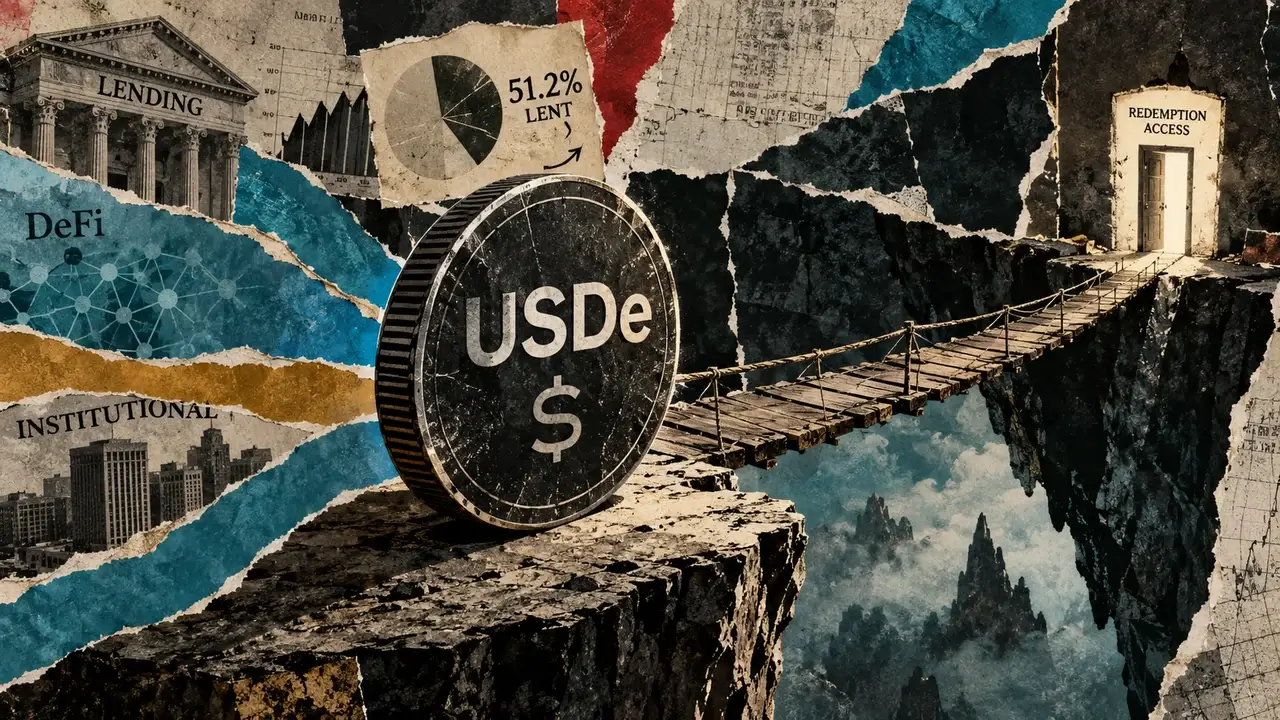
Ethena’s USDe, a synthetic dollar targeting $1, has 51.2% of its backing allocated to DeFi and institutional lending, according to risk assessor LlamaRisk’s October 12 assessment . The allocation figure does not measure actual borrower drawdowns or cash available for immediate withdrawal. For holders, usable reserve assets and access to an exit near the peg are separate tests.
Eligible counterparties can redeem USDe directly with Ethena, subject to its conditions. Other holders rely on secondary markets for an exit. Withdrawing USDe from sUSDe, its staking vault share, requires a separate unstaking process. A lending position can have excess collateral while supplied stablecoins remain borrowed. Recovering those assets depends on available pool liquidity or the applicable loan agreement’s recall and redelivery provisions.
The global snapshot reports $4.76 billion of backing against 4.76 billion USDe outstanding. Its lending allocations are 36.9% DeFi and 14.3% institutional, alongside 24.9% liquid stablecoins, 17.6% crypto basis and 6.0% real-world assets.
LlamaRisk discloses partial Aave DAO funding and its independent Ethena proof-of-reserves attestation role. It says it received no protocol or affiliated-entity compensation for this assessment.
The diversification itself predates this snapshot. Ethena’s March governance discussions already described lending deployments, and CryptoSlate covered the broader backing shift in August .
Ethena’s DeFi lending policy describes reviewed markets with excess borrower collateral, conservative loan-to-value parameters and exposure limits subject to governance and Risk Committee review. Those safeguards aim to limit losses. Aave and Morpho’s withdrawal mechanics determine whether underlying assets are available to recover.
Under Aave’s withdrawal rules , a supplier can take out only the amount available in a pool that has not been borrowed. Morpho’s market design also makes sufficient liquidity a condition for withdrawal.
For institutional lending, Ethena describes stable-asset loans backed by collateral worth more than the amount borrowed, including liquid BTC and ETH. Qualified custody and triparty arrangements, in which an independent agent holds and administers collateral, are designed to protect the protocol’s claim. Counterparty eligibility and aggregate exposure limits are subject to committee oversight.
Crypto Profit & Yield Calculator
Simulate trading returns, staking APY, and crypto gains with real-time fee modeling.
Source: CryptoSlate.
Read the full story at the original source ↗
For questions: mrsmithcons@gmail.com.
❓ Frequently Asked Questions (Bitcoin Run Alpha Briefing)
What on-chain catalyst or market signal triggered this Bitcoin Run Alpha movement?
Institutional on-chain telemetry, cold storage accumulation, and derivative funding rates indicate spot liquidity positioning that underpins this Bitcoin Run Alpha development.
How should investors interpret current liquidity pools and network hash activity?
Derivative funding remains balanced and exchange reserves continue trending downward, mitigating systemic liquidation cascades and strengthening the underlying structural floor.
Where are the critical technical support and invalidation levels?
Anchored volume-weighted average price (VWAP) benchmarks and high-density order book clusters near prior consolidation ranges serve as key risk management thresholds.
💎 On-Chain Wallet Tracking & Breakout Targets
Direct wallet address monitoring, smart money flows, and liquidity depth.
⚡ Track Whale Wallets Now ➔More from CryptoAce VIP


Most Crypto Casino Money No Longer Moves in Bitcoin — Stablecoins Took Over
Stablecoins now represent an estimated 60 to 70 percent of crypto casino transaction volume, while market lead...
 ₿ Lucky Satoshi
Alex Gladstein: How The Bitcoin-AI Convergence Impacts the Fight for Freedom
Bitcoin Magazine Alex Gladstein: How The Bitcoin-AI Convergence Impacts the Fight for Freedom AI risk isn't hu...
Bitcoin Crashes Below $82K: How Live Bettors Are Playing the Liquidation Cascade
Bitcoin fell below $82,000 as $771M in leveraged positions were wiped out. Here is how in-play crypto bettors ...
 📈 1UpTrade Live
El FMI descubre que más de la mitad de las transacciones de acciones estadounidenses tokenizadas se realizan después del cierre de Wall Street
Más de la mitad del volumen de la muestra de cinco productos se produjo fuera del horario habitual de Estados ...