Why Trump backed a crypto ethics rule that stopped at the family business
Story summary
Washington came surprisingly close this week to writing a dollar amount into one of its thorniest crypto ethics rule debates. Under the final Senate draft of the CLARITY Act, senior federal officials holding equity worth at least $15,000 in certain businesses that issue or sponsor digital assets wou
📌 Key Highlights & Takeaways
- Washington came surprisingly close this week to writing a dollar amount into one of its thorniest crypto ethics rule debates.
- Under the final Senate draft of the CLARITY Act, senior federal officials holding equity worth at least $15,000 in certain businesses that issue or sponsor digital assets wou
Washington came surprisingly close this week to writing a dollar amount into one of its thorniest crypto ethics rule debates.
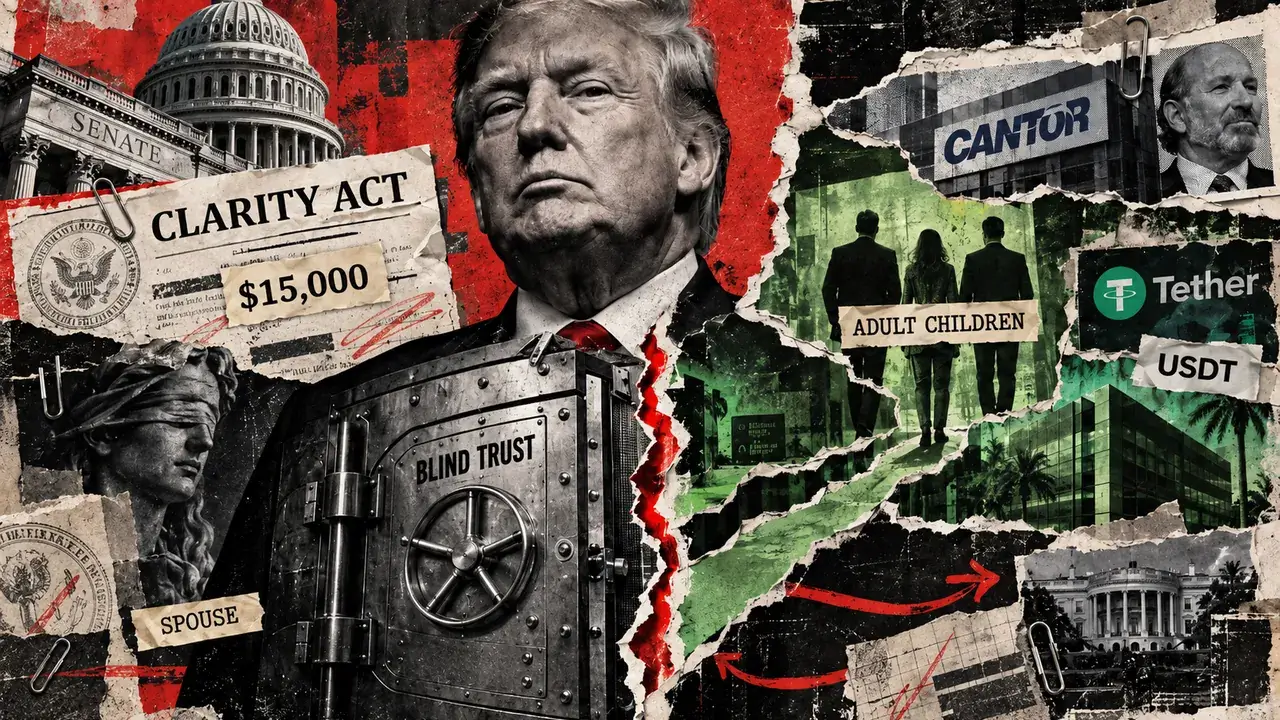
Under the final Senate draft of the CLARITY Act , senior federal officials holding equity worth at least $15,000 in certain businesses that issue or sponsor digital assets would have had to sell that interest or place it into a qualified blind trust. Their spouses would have faced the same restriction, but their adult children wouldn't.
The bill failed to advance on Sept. 15 , so none of this became law. But the language is revealing because CLARITY was primarily supposed to establish who regulates crypto markets and under what rules. By the end of the negotiations, Congress was also trying to decide where a government official's crypto fortune ends and the family's begins. Republicans said the final draft incorporated most of a bipartisan ethics proposal and dozens of changes requested by Democrats, while several Democrats still argued that the protections didn't go far enough.
Commerce Secretary Howard Lutnick shows why those distinctions matter in real life.
Lutnick spent decades running Cantor Fitzgerald, one of Wall Street's major trading and investment firms, before joining President Donald Trump's Cabinet in February 2025. Cantor also became deeply embedded in crypto through its relationship with Tether , the company behind USDT , the world's largest stablecoin. The firm has held billions of dollars of Treasuries for Tether and remains involved in its US business, including as reserve custodian and preferred primary dealer for Tether's regulated US stablecoin.
When Lutnick entered government, he stepped down from Cantor and later transferred his ownership through trusts benefiting his adult children. His son Brandon now runs the company and controls the trusts holding the voting interests. SEC filings show that after the October 2025 transfer, Howard Lutnick no longer held beneficial ownership of the securities tied to that control structure.
Legally, that's an important separation. But economically, the family remains heavily exposed to the same business.
That gap between the official and the family is exactly where the proposed crypto rules become interesting.
Crypto Profit & Yield Calculator
Simulate trading returns, staking APY, and crypto gains with real-time fee modeling.
Source: CryptoSlate.
On-Chain Whale Radar: Smart Money Cold Wallet Outflows & High-Yield DeFi Opportunities
Uncover high-yield crypto alpha, on-chain whale accumulation alerts, 100x altcoin gems, and automated DeFi yield opportunities before the retail crowd.
Track Whale Wallets ➔💎 On-Chain Wallet Tracking & Breakout Targets
Direct wallet address monitoring, smart money flows, and liquidity depth.
⚡ Track Whale Wallets Now ➔More from CryptoAce VIP

 🚀 RocketCoin Casino
TIGSoftwares Broadens Development Offering Across Turnkey and Crypto Casino Models
Breaking coverage reported by EIN Presswire: TIGSoftwares Broadens Development Offering Across Turnkey and Cry...
 ₿ Lucky Satoshi
CFTC Sends Proposal To Regulate Crypto Transactions Following Clarity Act Fail
Bitcoin Magazine CFTC Sends Proposal To Regulate Crypto Transactions Following Clarity Act Fail The regulator ...
 ⚡ LiveCoin Bet
A Better Trade Than Bitcoin or Gold in 2026 Is Sitting in Your Kitchen
Raw sugar futures have gained roughly 20% in 2026, outpacing Bitcoin (BTC), gold, and the S&P 500 as the Europ...
 🎁 Get Rich Free
Crypto Airdrops 2026: Free Tokens & Live Tracker - Page 30
Breaking coverage reported by Coin Gabbar: Crypto Airdrops 2026: Free Tokens & Live Tracker - Page 30. Our new...