PropAMMs lower Solana trade costs, and public pool returns crash
Story summary
A September preprint finds cheaper quiet-market SOL/USDC execution at professional pools, while passive depositor returns require separate accounting. The post PropAMMs lower Solana trade costs, and public pool returns crash appeared first on CryptoSlate.
📌 Key Highlights & Takeaways
- A September preprint finds cheaper quiet-market SOL/USDC execution at professional pools, while passive depositor returns require separate accounting.
- The post PropAMMs lower Solana trade costs, and public pool returns crash appeared first on CryptoSlate.
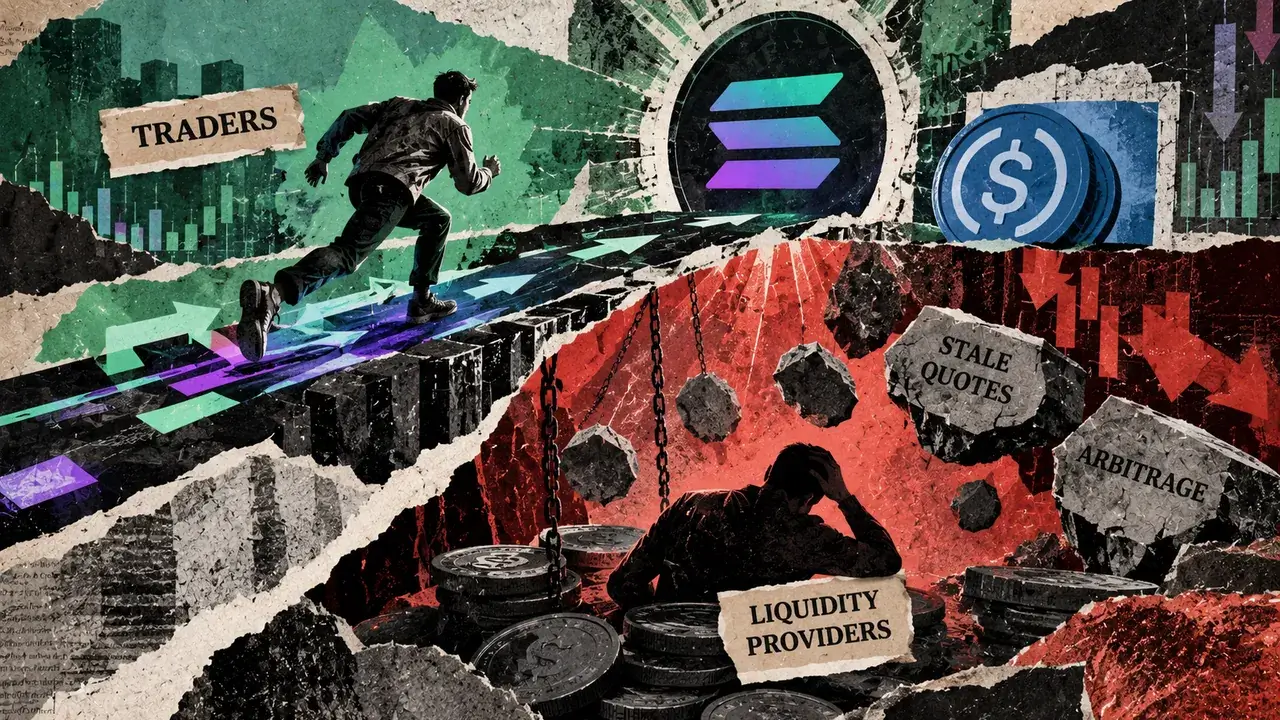
A trader can get a better Solana (SOL) swap price while a passive pool depositor remains exposed to traders picking off stale quotes, and a Sept. 29 preprint measures that divide.
For quiet-market SOL/USDC fills, propAMMs, pools controlled by professional operators, had a reference-relative execution cost proxy of 0.26 basis points versus 2.59 for public automated market makers (AMMs).
The study covers Sept. 1, 2025, through Aug. 31, 2026, with shorter Base and Monad samples. It weights fills by notional against Bybit's size-weighted top-of-book USDT microprice, converted with its USDC/USDT midpoint. Its authors list ETH Zurich and Category Labs affiliations.
A swapper wants more tokens for the same input, while a depositor supplies the inventory others trade against and needs compensation for the risks that inventory carries. Low execution cost can attract the first participant without being a sufficient investment case for the second.
Across its Solana sample , the paper reports two-second gross maker markouts of +0.37 basis points for propAMMs and −0.22 for public AMMs. A markout compares a fill with a later reference price, and a positive number favors the maker.
Quiet-flow execution asks how much a trader gives up against a relatively stable reference. The proxy requires less than 1 basis point of reference movement from five seconds before to one second after a fill.
Maker markouts ask what happens to a trade's value after the pool accepts it. Mixing the measures would turn evidence about pricing and adverse selection into a profitability claim the numbers cannot support.
When an outside market moves first, a pool still offering an old price can sell too cheaply or buy too dearly. An arbitrageur brings the prices back into line, but the correction comes through a trade against the liquidity already sitting in the pool.
Crypto Profit & Yield Calculator
Simulate trading returns, staking APY, and crypto gains with real-time fee modeling.
Source: CryptoSlate.
Read the full story at the original source ↗
For questions: mrsmithcons@gmail.com.
💎 On-Chain Wallet Tracking & Breakout Targets
Direct wallet address monitoring, smart money flows, and liquidity depth.
⚡ Track Whale Wallets Now ➔More from CryptoAce VIP


 🪙 FreeFortune Crypto
Jito Surges 39% As Solana Liquid Staking Competition Heats Up
Breaking coverage: Jito Surges 39% As Solana Liquid Staking Competition Heats Up. Comprehensive monitoring, on...
 📈 FreeRich FIRE
Many Americans are making these 2 retirement savings mistakes, one top investment strategist says
Breaking coverage reported by Business Insider: Many Americans are making these 2 retirement savings mistakes,...
 🚀 RocketCoin Casino
Best Bitcoin Casinos Ranked: Top 5 Highest-Paying Crypto Sites to Try in 2026
Breaking coverage reported by Sports Gambling Podcast: Best Bitcoin Casinos Ranked: Top 5 Highest-Paying Crypt...
 ₿ Lucky Satoshi
Darius Dale: Will Global Liquidity Send Bitcoin Higher in 2027?
Bitcoin Magazine Darius Dale: Will Global Liquidity Send Bitcoin Higher in 2027? Darius Dale warns near-term l...