Senate tax bill frees stablecoin spending while Bitcoin stays on IRS forms
Story summary
The circulated proposal would give eligible dollar-stablecoin purchases no-gain/no-loss treatment without a stated value cap, while ordinary Bitcoin spending retains disposition reporting. The post Senate tax bill frees stablecoin spending while Bitcoin stays on IRS forms appeared first on CryptoSla
📌 Key Highlights & Takeaways
- The circulated proposal would give eligible dollar-stablecoin purchases no-gain/no-loss treatment without a stated value cap, while ordinary Bitcoin spending retains disposition reporting.
- The post Senate tax bill frees stablecoin spending while Bitcoin stays on IRS forms appeared first on CryptoSla
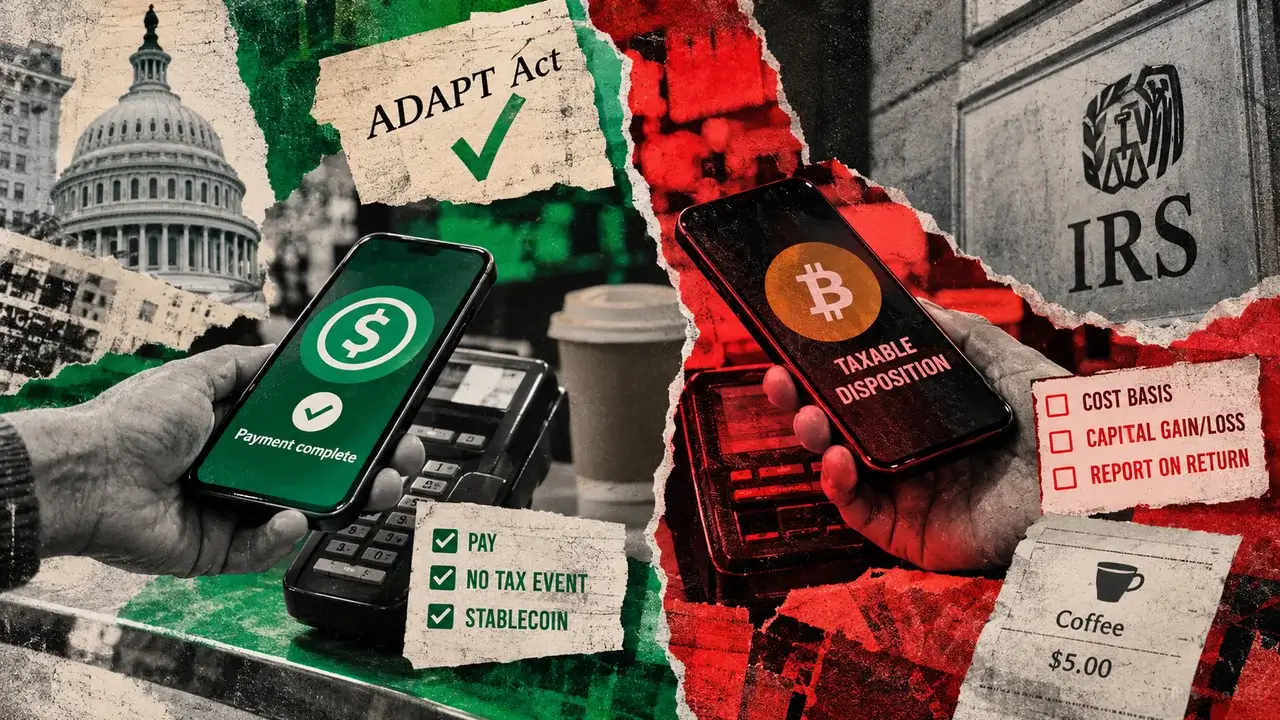
A coffee bought with a qualifying dollar stablecoin would avoid gain-or-loss recognition under the ADAPT Act that Sen. Steve Daines released Sept. 30. The same coffee bought with Bitcoin would still trigger the cost-basis calculation and capital gain or loss reporting that attach to spending digital assets.
Bloomberg Law reported Sept. 25 that Daines had circulated a draft and expected to introduce it the next week. The 56-page text released Sept. 30 carries the title Aligning Digital Assets with Principles of Taxation Act and lists Sens. Cynthia Lummis , Bernie Moreno and Tim Scott of South Carolina as cosponsors.
Under current IRS guidance, paying for goods or services with digital assets in any amount is a disposition. Holders of personal or investment assets must calculate and report capital gain or loss, which depends on the asset's value and cost basis.
A payment can produce a gain, a loss, or a break-even result, and the IRS uses a cup of coffee as its own example. A $5 Bitcoin purchase with an allocated basis of $3 produces a $2 capital gain that belongs on the return.
New section 1034 of the tax code would treat the disposition of covered payment stablecoins to buy products or services as a nonrecognition event. The relief covers gain or loss on the token itself, and sales taxes and other purchase obligations stay in place.
The token must be a qualified US dollar stablecoin, meaning one issued by a permitted payment stablecoin issuer under the GENIUS Act .
A foreign issuer qualifies through OCC registration or a Treasury finding that its home regime is comparable. It must appear in Treasury's most recent report before the payment, and the taxpayer must have acquired it at a price within 3% of $1.00.
Treasury would publish that report at least every three months, listing each qualified stablecoin actively traded within 3% of $1.00 during the 12 months ending the prior month. Users and payment companies would check the latest list when making a purchase.
Crypto Profit & Yield Calculator
Simulate trading returns, staking APY, and crypto gains with real-time fee modeling.
Source: CryptoSlate.
Read the full story at the original source ↗
For questions: mrsmithcons@gmail.com.
💎 On-Chain Wallet Tracking & Breakout Targets
Direct wallet address monitoring, smart money flows, and liquidity depth.
⚡ Track Whale Wallets Now ➔More from CryptoAce VIP



 🚀 RocketCoin Casino
Best Crypto Casinos 2026 – 5 Fastest Bitcoin Gambling Sites Ranked by Trust
Breaking coverage: Best Crypto Casinos 2026 – 5 Fastest Bitcoin Gambling Sites Ranked by Trust. Comprehensive ...
 ₿ Lucky Satoshi
The Quantum Issue: Quantum Isn’t Coming For Your Bitcoin
Bitcoin Magazine The Quantum Issue: Quantum Isn’t Coming For Your Bitcoin From The Quantum Issue: Brandon Blac...
 ⚡ LiveCoin Bet
Zcash Co-Founder Backs Shielded Bitcoin, Says His ZEC Year-End Target Is Still in Play
Zcash co-founder Eli Ben-Sasson backs Shielded Bitcoin for private L1 transfers and sticks with a $5,000 ZEC t...
 🪙 FreeFortune Crypto
Live updates: Bitcoin manages small gains as stocks drop on AI concern, oil surges
The Federal Reserve's two-day policy meeting begins tomorrow, with nearly all now expecting the U.S. central b...