US targets $17 billion Russia-linked crypto payment network using USDT as an escape route
Story summary
OFAC’s October 1 designation expands blocking sanctions to the broader network, while FinCEN’s separate sub-agent transfer restriction remains proposed. The post US targets $17 billion Russia-linked crypto payment network using USDT as an escape route appeared first on CryptoSlate.
📌 Key Highlights & Takeaways
- OFAC’s October 1 designation expands blocking sanctions to the broader network, while FinCEN’s separate sub-agent transfer restriction remains proposed.
- The post US targets $17 billion Russia-linked crypto payment network using USDT as an escape route appeared first on CryptoSlate.
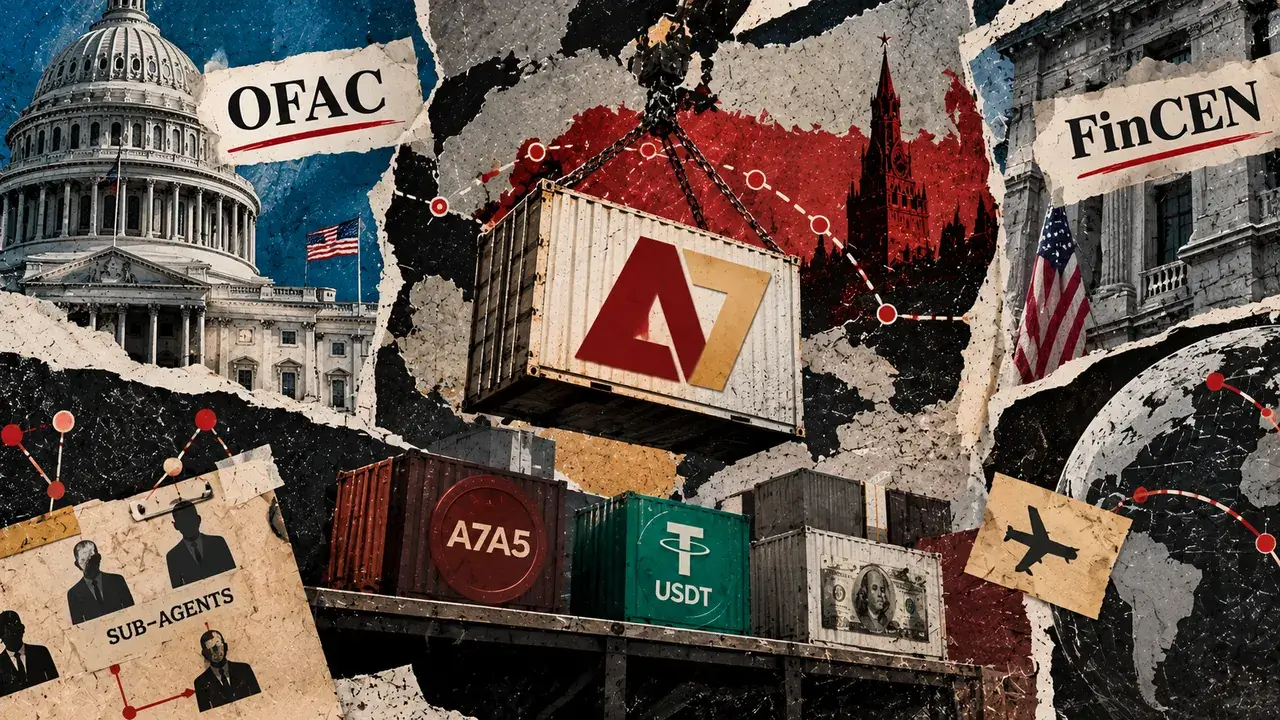
The US sanctioned the Russia-linked A7 Network and proposed new restrictions to cut its crypto intermediaries off from global markets.
On Oct. 1, the Treasury Department designated A7 as a significant transnational criminal organization, extending blocking sanctions beyond individual companies previously targeted by Washington to the broader payment network. FinCEN simultaneously proposed barring covered financial institutions from transmitting funds involving identified A7 sub-agents.
The measures target a shadow-payment system Treasury says has helped Russian sanctioned entities, Iran’s central bank and Islamic Revolutionary Guard Corps, and other illicit actors move money through companies designed to make restricted transactions resemble ordinary commercial payments.
FinCEN said A7 sub-agents processed more than $17 billion in dollar-denominated transactions between January 2025 and June 2026. Treasury separately said the network claimed in January to be handling more than 2,000 transactions a day worth the equivalent of $91.5 billion, or about 13% of Russia’s 2025 foreign trade.
The designation gives financial firms an immediate compliance obligation where US sanctions jurisdiction applies. Property and interests in property belonging to blocked persons must be frozen and reported to the Office of Foreign Assets Control, including entities owned 50% or more by sanctioned parties.
Crypto intermediaries are central to the broader effort because A7 has used its ruble-backed A7A5 token as a bridge into assets with deeper global liquidity.
FinCEN said A7A5 functions as an internal accounting and settlement asset backed by ruble deposits at sanctioned Russian bank PSB. The network has frequently converted the token into more widely accepted digital assets, including Tether’s USDT , which can subsequently be exchanged into fiat currency for international payments.
That route puts exchanges, over-the-counter brokers and other liquidity providers outside Russia under greater scrutiny. FinCEN said A7 relies on sub-agents and intermediaries to provide liquidity and move funds while masking the network’s involvement, including through trade documents and payment instructions that make sanctioned activity appear commercially legitimate.
Crypto Profit & Yield Calculator
Simulate trading returns, staking APY, and crypto gains with real-time fee modeling.
Source: CryptoSlate.
Read the full story at the original source ↗
For questions: mrsmithcons@gmail.com.
💎 On-Chain Wallet Tracking & Breakout Targets
Direct wallet address monitoring, smart money flows, and liquidity depth.
⚡ Track Whale Wallets Now ➔More from CryptoAce VIP
 🚀 RocketCoin Casino
Crypto Casinos 2026 - Bitcoin, Ethereum & Altcoin Casino Guide
Breaking coverage reported by 25yearslatersite.com: Crypto Casinos 2026 - Bitcoin, Ethereum & Altcoin Casino G...
 ₿ Lucky Satoshi
SEC Proposes New Rules On Crypto Custody
Bitcoin Magazine SEC Proposes New Rules On Crypto Custody The regulator proposed new rules it said would hel...
 ⚡ LiveCoin Bet
Crypto Casinos 2026 - JACK Highlights Market Trends with Instant Crypto Cashout Features
Breaking coverage reported by The Manila Times: Crypto Casinos 2026 - JACK Highlights Market Trends with Insta...
The Dirty Secret Behind a Tiny Country's Wealth: Where the Elite Hide Their Billions
Think you know Luxembourg? Think again! Dive into the secrets behind Europe's richest country—where tiny size ...