The same Fed rate hike can help stablecoins and hurt Bitcoin borrowers
Story summary
When you hold a dollar stablecoin, somebody else may be earning interest on the assets backing your balance, while a company borrowing to buy Bitcoin has to find the money to pay its lenders. Both businesses are crypto-native, but a higher interest rate can reward the first and eat into the economic
📌 Key Highlights & Takeaways
- When you hold a dollar stablecoin, somebody else may be earning interest on the assets backing your balance, while a company borrowing to buy Bitcoin has to find the money to pay its lenders.
- Both businesses are crypto-native, but a higher interest rate can reward the first and eat into the economic
When you hold a dollar stablecoin, somebody else may be earning interest on the assets backing your balance, while a company borrowing to buy Bitcoin has to find the money to pay its lenders.
Both businesses are crypto-native, but a higher interest rate can reward the first and eat into the economics of the second.
That split gets lost when every move in Treasury yields becomes a verdict on whether money is getting easier or harder for the whole industry.
Different rates reach different businesses through their contracts, so a bond-market move that discourages investors from buying speculative assets can also improve the income earned on some crypto reserves.
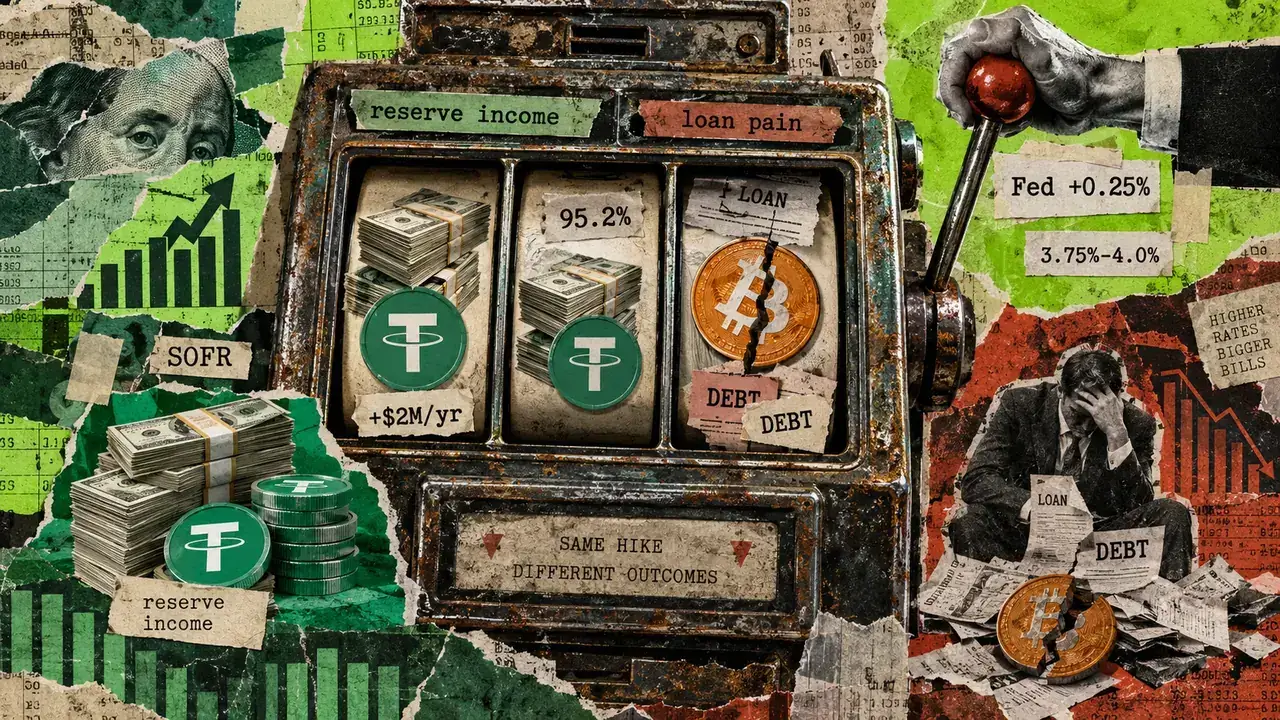
We can see this in Circle's second-quarter filing: reserve income supplied 95.2% of revenue in the three months ended June 30, 2026. Its reserve returns track close to the prevailing secured overnight financing rate (SOFR), leaving revenue heavily dependent on how many stablecoins are outstanding and what their backing earns.
The rate in that calculation is important because overnight returns and the 10-year Treasury yield can move differently. Treating both as the same price of money can leave you expecting a windfall at an issuer whose reserve income is actually headed in the other direction.
The Fed's Sept. 16 decision to raise its target range by a quarter of a percentage point, to 3.75%-4%, affected that split. Higher overnight rates can boost returns on short-term stablecoin reserves as assets mature or reset, while borrowers whose debt tracks those rates can face larger interest bills.
Short-term rates influence returns on instruments that mature or reset quickly, while a 10-year Treasury yield incorporates expectations about future short rates and compensation for holding a longer bond.
From an on-chain analytics and liquidity distribution perspective, developments around "The same Fed rate hike can help stablecoins and hurt Bitcoin borrowers" signal important shifts in network participation. Market participants observe that derivative funding metrics, exchange reserve telemetry, and smart contract protocol interactions reflect cautious accumulation alongside disciplined risk hedging across the sector.
Technical research analysts at CryptoAce VIP note that high-density order book clusters and volume-weighted average price (VWAP) benchmarks near recent consolidation floors will serve as pivotal indicators. Market observers are advised to cross-examine telemetry on verified block explorers before making capital allocations.
Editorial Fact-Check & Verification Note: This briefing was curated, corroborated, and synthesized by the CryptoAce VIP Editorial Desk. Readers following "The same Fed rate hike can help stablecoins and hurt Bitcoin borrowers" are encouraged to review the full primary source coverage linked below for complete historical context, direct quotes, and official statements.
Crypto Profit & Yield Calculator
Simulate trading returns, staking APY, and crypto gains with real-time fee modeling.
Source: CryptoSlate.
Read the full story at the original source ↗
For questions: mrsmithcons@gmail.com.
❓ Frequently Asked Questions (Bitcoin Run Alpha Briefing)
What on-chain catalyst or market signal triggered this Bitcoin Run Alpha movement?
Institutional on-chain telemetry, cold storage accumulation, and derivative funding rates indicate spot liquidity positioning that underpins this Bitcoin Run Alpha development.
How should investors interpret current liquidity pools and network hash activity?
Derivative funding remains balanced and exchange reserves continue trending downward, mitigating systemic liquidation cascades and strengthening the underlying structural floor.
Where are the critical technical support and invalidation levels?
Anchored volume-weighted average price (VWAP) benchmarks and high-density order book clusters near prior consolidation ranges serve as key risk management thresholds.
💎 On-Chain Wallet Tracking & Breakout Targets
Direct wallet address monitoring, smart money flows, and liquidity depth.
⚡ Track Whale Wallets Now ➔More from CryptoAce VIP

 ₿ Lucky Satoshi
Sazmining lança o Wild Sats Club, um programa de fidelidade que desconta taxas de gerenciamento de mineração à medida que a taxa de hash do cliente aumenta
Bitcoin Magazine Sazmining lança o Wild Sats Club, um programa de fidelidade que desconta taxas de gerenciamen...
 🚀 RocketCoin Casino
Melhores Crypto Casinos Malásia 2026 – Principais escolhas de cassino Bitcoin
Cobertura de última hora relatada por escapistmagazine.com: Melhores Crypto Casinos Malaysia 2026 – Principais...
 ⚡ LiveCoin Bet
O cofundador da Zcash apóia o Bitcoin protegido e afirma que sua meta de final de ano da ZEC ainda está em jogo
O cofundador da Zcash, Eli Ben-Sasson, apóia o Shielded Bitcoin para transferências privadas L1 e mantém uma m...
 📈 FreeRich FIRE
Retire early or retire rich? — here are 3 things that can help you do both
Breaking coverage reported by Yahoo Finance: Retire early or retire rich? — here are 3 things that can help yo...