Por que uma queda nas reservas bancárias de US$ 88 bilhões não prova um aperto de liquidez do Bitcoin – ainda
Story summary
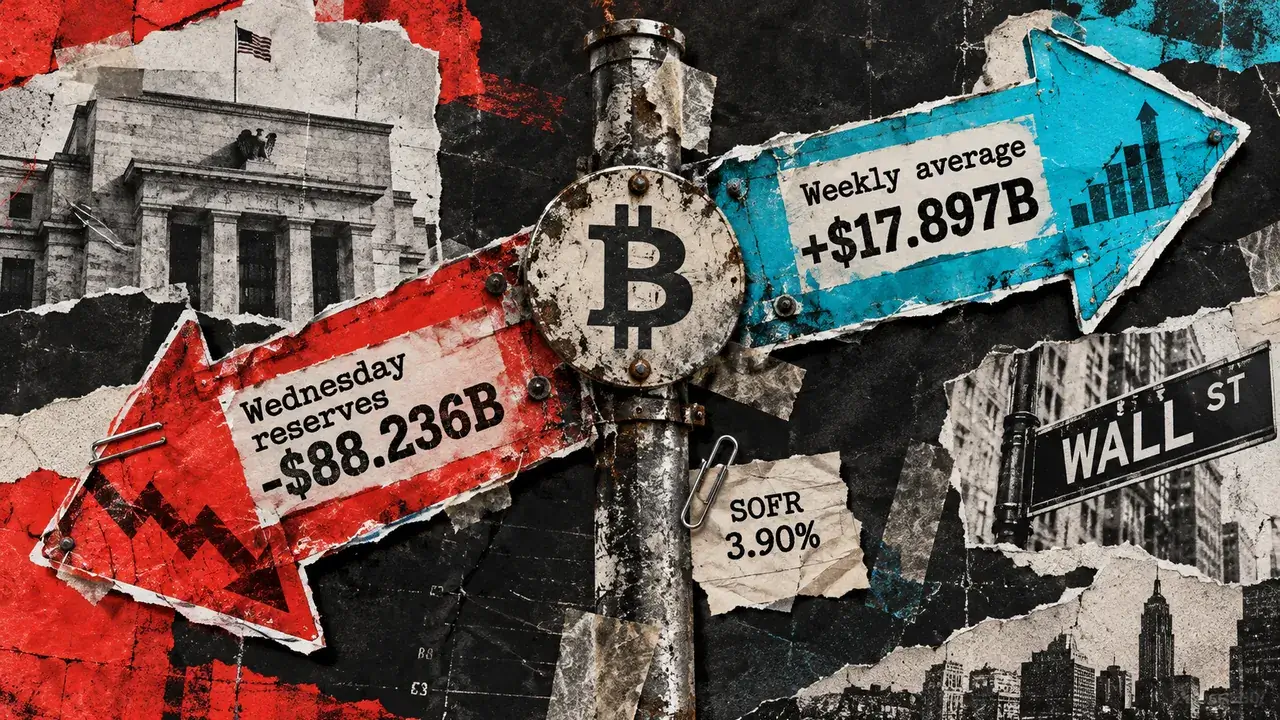
As reservas de quarta-feira caíram US$ 88,236 bilhões, enquanto sua média semanal aumentou US$ 17,897 bilhões, expondo os limites dos sinais de liquidez do Bitcoin baseados em reservas. A postagem Por que uma queda nas reservas bancárias de US$ 88 bilhões não prova um aperto de liquidez do Bitcoin – ainda apareceu pela primeira vez no CryptoSlate.
📌 Key Highlights & Takeaways
- As reservas de quarta-feira caíram US$ 88,236 bilhões, enquanto sua média semanal aumentou US$ 17,897 bilhões, expondo os limites dos sinais de liquidez do Bitcoin baseados em reservas.
- A postagem Por que uma queda nas reservas bancárias de US$ 88 bilhões não prova um aperto de liquidez do Bitcoin – ainda apareceu pela primeira vez no CryptoSlate.
Bitcoin’s quarter-end liquidity signal changes direction depending on which reserve measure is used. Federal Reserve data released Oct. 1 show bank reserves falling $88.236 billion between Sept. 23 and Sept. 30 Wednesday snapshots, while their weekly average rose $17.897 billion.
Reserves are balances banks hold at the Federal Reserve to make and receive payments. Their level matters for dollar financing, but a reserve chart alone cannot establish whether pressure reached Bitcoin. The balance-sheet decline is largely accounted for by Treasury cash and reverse repos, predominantly involving foreign official accounts. September 30’s median cost of Treasury-backed overnight borrowing was 3.90%, within the range of the five latest observed readings.
September’s quarter-end therefore offers a test of the measurements behind a liquidity thesis. An endpoint balance, an average balance and a funding price describe different aspects of the system. Treating them as interchangeable can turn the same week into opposing market signals.
The Wednesday reserve series fell from $2.969922 trillion on Sept. 23 to $2.881686 trillion on Sept. 30. The weekly-average series rose from $2.930193 trillion to $2.948090 trillion for the weeks ending on those dates.
Both readings come from the Fed’s H.4.1 release. One compares balances on two Wednesdays; the other compares averages of daily figures across two weeks. A lower final observation can coexist with a higher average, because the readings cover different time windows.
The Treasury General Account, the government’s account at the Fed, illustrates the same problem. Its Wednesday balance rose $36.729 billion to $984.046 billion. Its weekly average fell $28.410 billion to $948.674 billion.
Mixing the Wednesday reserve decline with the average Treasury decline would combine observations from different windows. It could obscure the very cash movement an investor is trying to explain. A chart labeled “weekly” still needs a second question: is each point a weekly average or a balance observed once a week?
The endpoint captures the quarter-end position. The average describes the level across the week. Neither provides a complete daily path or proves how persistent the final-day position will be. For a Bitcoin liquidity argument, choosing the window changes the evidence before any price forecast enters the discussion.
Crypto Profit & Yield Calculator
Simulate trading returns, staking APY, and crypto gains with real-time fee modeling.
Source: CryptoSlate.
Read the full story at the original source ↗
For questions: mrsmithcons@gmail.com.
💎 On-Chain Wallet Tracking & Breakout Targets
Direct wallet address monitoring, smart money flows, and liquidity depth.
⚡ Track Whale Wallets Now ➔More from CryptoAce VIP


 ₿ Lucky Satoshi
Darius Dale: A liquidez global aumentará o Bitcoin em 2027?
Revista Bitcoin Darius Dale: A liquidez global aumentará o Bitcoin em 2027? Darius Dale alerta que o aperto da...
![Atualizações ao vivo: Bitcoin gerencia pequenos ganhos à medida que as ações caem devido à preocupação com a IA e aumentos do petróleo [Revisado pelo analista sênior.]](https://images.unsplash.com/photo-1518770660439-4636190af475?w=1200&q=80) 🪙 FreeFortune Crypto
🪙 FreeFortune Crypto
Atualizações ao vivo: Bitcoin gerencia pequenos ganhos à medida que as ações caem devido à preocupação com a IA e aumentos do petróleo [Revisado pelo analista sênior.]
A reunião de política monetária de dois dias do Federal Reserve começa amanhã, com quase todos esperando que o...
 🚀 RocketCoin Casino
Crypto Casinos 2026 - Bitcoin, Ethereum & Altcoin Casino Guide
Breaking coverage reported by 25yearslatersite.com: Crypto Casinos 2026 - Bitcoin, Ethereum & Altcoin Casino G...
 ⚡ LiveCoin Bet
O cofundador da Zcash apóia o Bitcoin protegido e afirma que sua meta de final de ano da ZEC ainda está em jogo
O cofundador da Zcash, Eli Ben-Sasson, apóia o Shielded Bitcoin para transferências privadas L1 e mantém uma m...