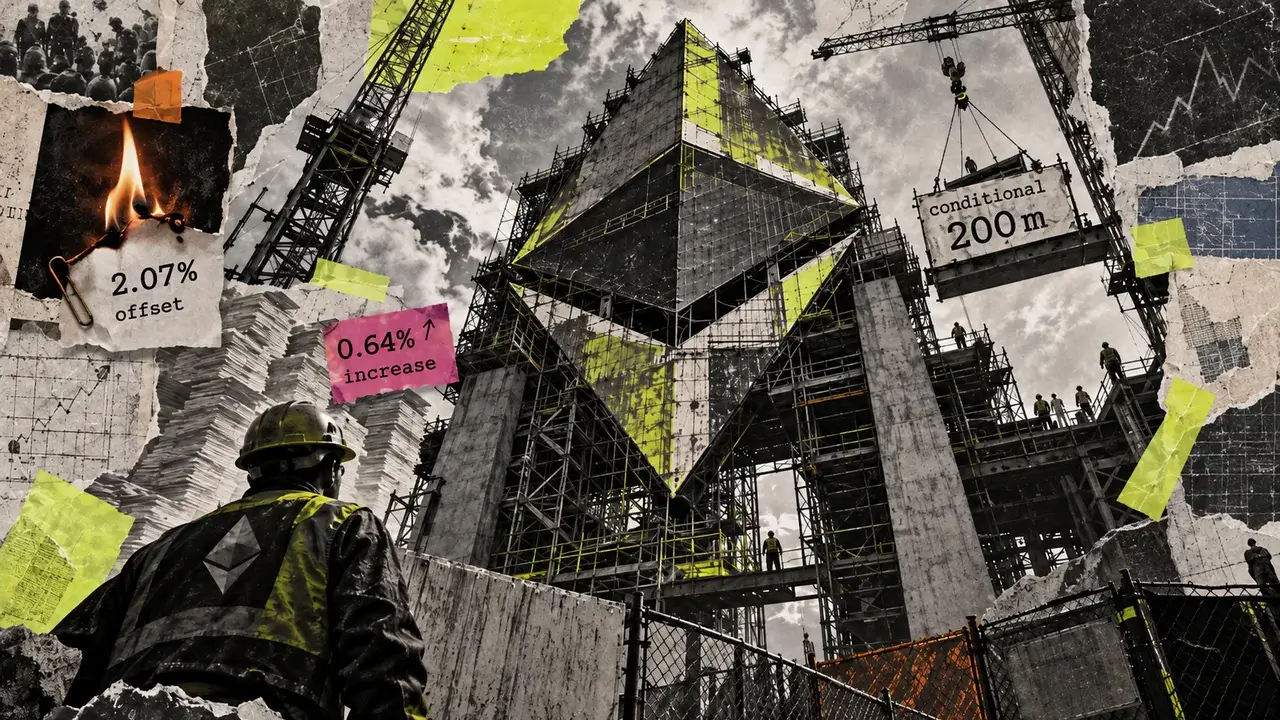
Сжигание комиссий ETH покрывает лишь 2% новых монет, напечатанных в 2026 году.
Story summary
Согласно отчету от 9 октября, сжигание комиссий составляет 2,07% от валового выпуска, в то время как модель условной мощности проверяет спрос, необходимый для сокращения предложения. Сжигание комиссий после ETH покрывает лишь 2% новых монет, напечатанных в 2026 году и впервые появившихся на CryptoSlate.
📌 Key Highlights & Takeaways
- Согласно отчету от 9 октября, сжигание комиссий составляет 2,07% от валового выпуска, в то время как модель условной мощности проверяет спрос, необходимый для сокращения предложения.
- Сжигание комиссий после ETH покрывает лишь 2% новых монет, напечатанных в 2026 году и впервые появившихся на CryptoSlate.
Ethereum's transaction fees have burned enough ETH to offset just 2.07% of the new coins issued in 2026, according to an Oct. 9 supply ledger.
After fee burn, validator penalties, and other destruction, the network has added approximately 778,413 ETH, increasing supply by about 0.64% from the window's opening level.
A larger gas limit can spread the necessary fee spending across more activity, lowering the required fee per gas and creating a hurdle for holders that expect scalability to make ETH scarcer. Developers pursue a conditional 200 million maximum gas goal after the Glamsterdam upgrade.
Using one current finalized accounting sample, an illustration puts the execution base fee needed to offset gross issuance at about 13.85 gwei with today's 60 million gas limit, or 4.16 gwei with a hypothetical 200 million limit.
Both require roughly 2,992 ETH of daily burn under the model's assumptions.
The ethsupply.fyi retained ledger covers Jan. 1 at 00:00:11 UTC through Oct. 9 at 15:44:23 UTC. It reports 796,623.377 ETH of gross issuance against 16,524.553 ETH destroyed through execution and blob transaction fees.
A further 1,685.919 ETH was removed through consensus penalties, with 0.059 ETH in other execution destruction. Subtracting these components leaves 778,412.846 ETH in net additions.
Those categories explain why the fee-burn offset is 2.074%, while the offset from all destruction is 2.286%. The latter includes penalties that do not represent customers paying for Ethereum activity . Treating the larger figure as transaction-fee demand would overstate how much issuance users have offset.
From an on-chain analytics and liquidity distribution perspective, developments around "Сжигание комиссий ETH покрывает лишь 2% новых монет, напечатанных в 2026 году." signal important shifts in network participation. Market participants observe that derivative funding metrics, exchange reserve telemetry, and smart contract protocol interactions reflect cautious accumulation alongside disciplined risk hedging across the sector.
Technical research analysts at CryptoAce VIP note that high-density order book clusters and volume-weighted average price (VWAP) benchmarks near recent consolidation floors will serve as pivotal indicators. Market observers are advised to cross-examine telemetry on verified block explorers before making capital allocations.
Editorial Fact-Check & Verification Note: This briefing was curated, corroborated, and synthesized by the CryptoAce VIP Editorial Desk. Readers following "Сжигание комиссий ETH покрывает лишь 2% новых монет, напечатанных в 2026 году." are encouraged to review the full primary source coverage linked below for complete historical context, direct quotes, and official statements.
Crypto Profit & Yield Calculator
Simulate trading returns, staking APY, and crypto gains with real-time fee modeling.
Source: CryptoSlate.
Read the full story at the original source ↗
For questions: mrsmithcons@gmail.com.
❓ Frequently Asked Questions (Whale Tracking Briefing)
What on-chain catalyst or market signal triggered this Whale Tracking movement?
Institutional on-chain telemetry, cold storage accumulation, and derivative funding rates indicate spot liquidity positioning that underpins this Whale Tracking development.
How should investors interpret current liquidity pools and network hash activity?
Derivative funding remains balanced and exchange reserves continue trending downward, mitigating systemic liquidation cascades and strengthening the underlying structural floor.
Where are the critical technical support and invalidation levels?
Anchored volume-weighted average price (VWAP) benchmarks and high-density order book clusters near prior consolidation ranges serve as key risk management thresholds.
💎 On-Chain Wallet Tracking & Breakout Targets
Direct wallet address monitoring, smart money flows, and liquidity depth.
⚡ Track Whale Wallets Now ➔More from CryptoAce VIP

 ₿ Lucky Satoshi
2026 Industry Analysis: Crypto DCA (Dollar-Cost Averaging) Calculator (Day 3 Guide)
Why experts rely on Crypto DCA (Dollar-Cost Averaging) Calculator on Lucky Satoshi. Discover essential market ...
 ⚡ LiveCoin Bet
2026 Industry Analysis: Implied Probability & Bookmaker Overround (Vig) Calculator (Day 3 Guide)
Why experts rely on Implied Probability & Bookmaker Overround (Vig) Calculator on LiveCoin Bet. Discover essen...
 💎 Try2Rich
2026 Industry Analysis: Loan Markup & Total Repayment Calculator (Day 3 Guide)
Why experts rely on Loan Markup & Total Repayment Calculator on Try2Rich. Discover essential market trends, te...
 🎁 Get Rich Free
Воздушная доставка с Фароса: срок подачи претензий истекает 25 октября 2026 г.
Экстренное освещение, сообщенное CryptoTicker: Pharos Airdrop: срок подачи претензий истекает 25 октября 2026 ...