Стейблкоины, возможно, не истощат банки долларов, но они все равно могут сделать кредитование более дорогим.
Story summary
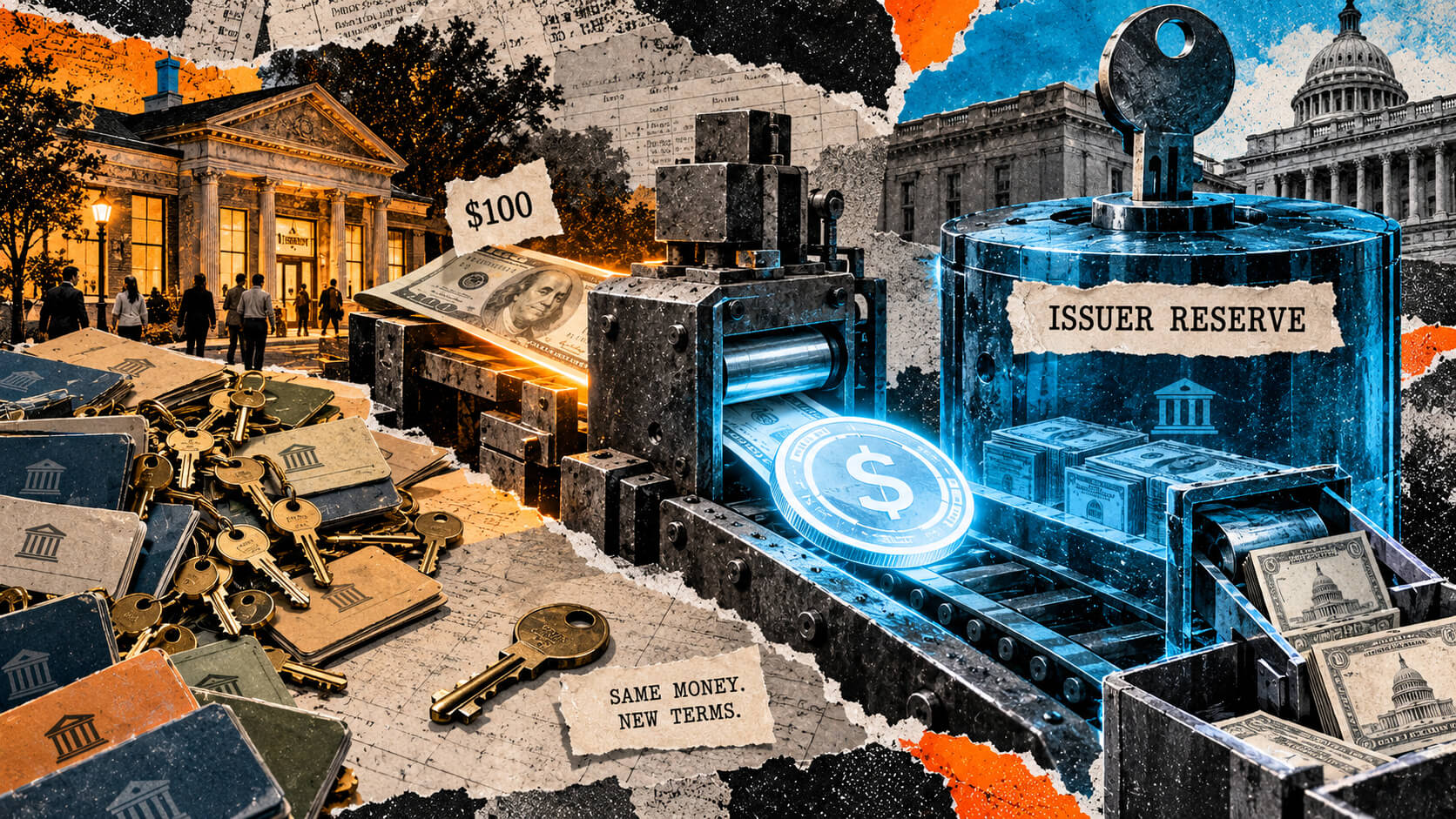
Вот гипотетический сценарий: вы хотите использовать 100 долларов со своего банковского счета для покупки недавно выпущенных стейблкоинов. Компания, выпускающая стейблкоины, берет ваши доллары, помещает их на свой банковский счет и дает вам остаток, который вы можете отправить через блокчейн. Вы получили продукт, который хотели, и
📌 Key Highlights & Takeaways
- Вот гипотетический сценарий: вы хотите использовать 100 долларов со своего банковского счета для покупки недавно выпущенных стейблкоинов.
- Компания, выпускающая стейблкоины, берет ваши доллары, помещает их на свой банковский счет и дает вам остаток, который вы можете отправить через блокчейн.
- Вы получили продукт, который хотели, и
Here's a hypothetical scenario: you want to use $100 out of your bank account to buy newly issued stablecoins. The company issuing the stablecoins takes your dollars, puts them in its own bank account, and gives you a balance you can send around on a blockchain.
You got the product you wanted, and somewhere in the vast and confusing realm of banking, the $100 is still there.
From a distance, this looks like something banks shouldn't worry about. Sure, they lost a deposit, but they also got a deposit back, so why do bankers keep warning that stablecoins could drain the financial system?
The thing is, your bank really liked having you as the customer. If you take your money away, now it owes that money to a company managing withdrawals for thousands of people, with someone paid to decide where the reserves should go.
The dollars came back, but they came back with a different owner, and that owner can be a much more demanding creditor.
This is the part of the stablecoin debate that gets lost when everyone starts estimating how many trillions will leave banks. The amount in the bank can stay the same while the bank gets a much worse deal, because a deposit's value to a bank depends partly on how long the customer will leave it there and what it costs to keep it.
The Bank for International Settlements' 2026 analysis used a $100 purchase to show how household deposits can return as issuer deposits while making banks' funding less dependable under regulatory measures.
If banks have to spend more to support that money, some of the cost could eventually reach people taking out loans, including people who don't even know what a stablecoin is.
From an on-chain analytics and liquidity distribution perspective, developments around "Стейблкоины, возможно, не истощат банки долларов, но они все равно могут сделать кредитование более дорогим." signal important shifts in network participation. Market participants observe that derivative funding metrics, exchange reserve telemetry, and smart contract protocol interactions reflect cautious accumulation alongside disciplined risk hedging across the sector.
Technical research analysts at CryptoAce VIP note that high-density order book clusters and volume-weighted average price (VWAP) benchmarks near recent consolidation floors will serve as pivotal indicators. Market observers are advised to cross-examine telemetry on verified block explorers before making capital allocations.
Editorial Fact-Check & Verification Note: This briefing was curated, corroborated, and synthesized by the CryptoAce VIP Editorial Desk. Readers following "Стейблкоины, возможно, не истощат банки долларов, но они все равно могут сделать кредитование более дорогим." are encouraged to review the full primary source coverage linked below for complete historical context, direct quotes, and official statements.
Crypto Profit & Yield Calculator
Simulate trading returns, staking APY, and crypto gains with real-time fee modeling.
Source: CryptoSlate.
Read the full story at the original source ↗
For questions: mrsmithcons@gmail.com.
❓ Frequently Asked Questions (Whale Tracking Briefing)
What on-chain catalyst or market signal triggered this Whale Tracking movement?
Institutional on-chain telemetry, cold storage accumulation, and derivative funding rates indicate spot liquidity positioning that underpins this Whale Tracking development.
How should investors interpret current liquidity pools and network hash activity?
Derivative funding remains balanced and exchange reserves continue trending downward, mitigating systemic liquidation cascades and strengthening the underlying structural floor.
Where are the critical technical support and invalidation levels?
Anchored volume-weighted average price (VWAP) benchmarks and high-density order book clusters near prior consolidation ranges serve as key risk management thresholds.
💎 On-Chain Wallet Tracking & Breakout Targets
Direct wallet address monitoring, smart money flows, and liquidity depth.
⚡ Track Whale Wallets Now ➔More from CryptoAce VIP

 ₿ Lucky Satoshi
Когда банки не работают, Биткойн работает: индекс принятия Корнеллского университета
Журнал «Биткойн» Когда банки не работают, Биткойн работает: Индекс принятия Корнельского университета Корнельс...
 ⚡ LiveCoin Bet
Соучредитель Zcash поддерживает защищенный биткойн и говорит, что его цель ZEC на конец года все еще в силе
Соучредитель Zcash Эли Бен-Сассон поддерживает Shielded Bitcoin для частных переводов L1 и придерживается цели...
 💰 Free2Rich Online
5 Side Hustles That Actually Make $1K or More per Month
Breaking coverage reported by AOL.com: 5 Side Hustles That Actually Make $1K or More per Month. Our news desk ...
 📈 FreeRich FIRE
Real-estate investors who started with little savings share 4 creative ways they bought property
Breaking coverage reported by Business Insider: Real-estate investors who started with little savings share 4 ...