New Treasury rules could change how stablecoin issuers get your dollars back
Story summary
US government debt is one of the easiest assets in the world to borrow against, which lets financial companies get cash without giving up their investments for good. Washington is rewriting the rules for that borrowing, and the result will reach crypto through the companies that keep Treasury securi
📌 Key Highlights & Takeaways
- US government debt is one of the easiest assets in the world to borrow against, which lets financial companies get cash without giving up their investments for good.
- Washington is rewriting the rules for that borrowing, and the result will reach crypto through the companies that keep Treasury securi
US government debt is one of the easiest assets in the world to borrow against, which lets financial companies get cash without giving up their investments for good.
Washington is rewriting the rules for that borrowing, and the result will reach crypto through the companies that keep Treasury securities behind their dollar tokens.
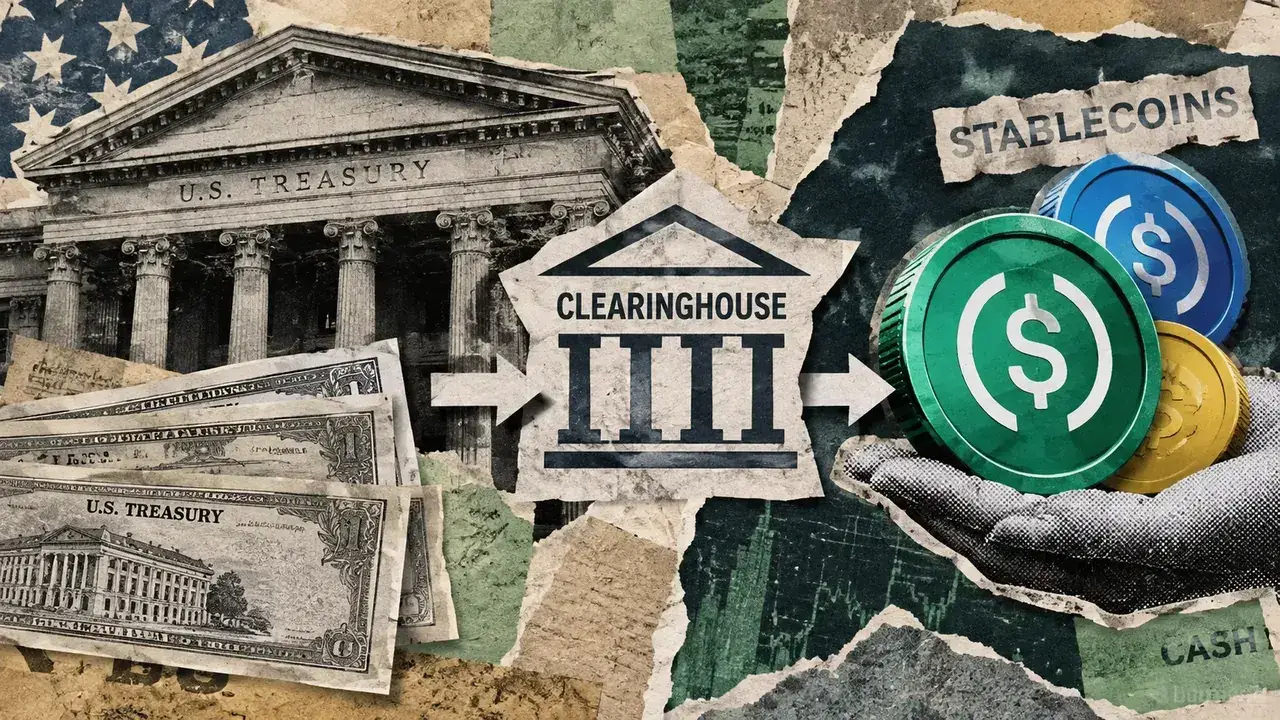
The SEC wants more Treasury transactions to pass through a central clearinghouse, an institution that becomes the buyer to each seller and the seller to each buyer.
If one trading company fails, the other side can look to the clearinghouse to complete the covered trade, under its rules, instead of trying to recover everything from the failed company itself.
Providing that kind of protection takes a lot of money, so the new system will also affect what companies pay to trade and borrow. Stablecoin issuers depend on those services when they need to convert reserve assets into dollars for customers, so the cost and availability of Treasury trading affect how well their tokens work.
The SEC's deadlines are Dec. 31 for eligible outright purchases and sales of Treasuries, followed by June 30, 2027, for eligible repurchase agreements, known as repos. Commissioner Mark Uyeda said on Sept. 22 that the agency didn't currently intend to extend them.
These requirements cover specified trades involving clearing members, rather than every purchase of a Treasury by anyone who owns one.
Suppose an investment fund owns Treasury securities but needs dollars today, before the government is due to repay it. The fund could sell some of those securities, or it could use a repo: sell them now with an agreement to buy them back on a set date, often the next day, for a slightly higher price.
From an on-chain analytics and liquidity distribution perspective, developments around "New Treasury rules could change how stablecoin issuers get your dollars back" signal important shifts in network participation. Market participants observe that derivative funding metrics, exchange reserve telemetry, and smart contract protocol interactions reflect cautious accumulation alongside disciplined risk hedging across the sector.
Technical research analysts at CryptoAce VIP note that high-density order book clusters and volume-weighted average price (VWAP) benchmarks near recent consolidation floors will serve as pivotal indicators. Market observers are advised to cross-examine telemetry on verified block explorers before making capital allocations.
Editorial Fact-Check & Verification Note: This briefing was curated, corroborated, and synthesized by the CryptoAce VIP Editorial Desk. Readers following "New Treasury rules could change how stablecoin issuers get your dollars back" are encouraged to review the full primary source coverage linked below for complete historical context, direct quotes, and official statements.
Crypto Profit & Yield Calculator
Simulate trading returns, staking APY, and crypto gains with real-time fee modeling.
Source: CryptoSlate.
Read the full story at the original source ↗
For questions: mrsmithcons@gmail.com.
❓ Frequently Asked Questions (Whale Tracking Briefing)
What on-chain catalyst or market signal triggered this Whale Tracking movement?
Institutional on-chain telemetry, cold storage accumulation, and derivative funding rates indicate spot liquidity positioning that underpins this Whale Tracking development.
How should investors interpret current liquidity pools and network hash activity?
Derivative funding remains balanced and exchange reserves continue trending downward, mitigating systemic liquidation cascades and strengthening the underlying structural floor.
Where are the critical technical support and invalidation levels?
Anchored volume-weighted average price (VWAP) benchmarks and high-density order book clusters near prior consolidation ranges serve as key risk management thresholds.
💎 On-Chain Wallet Tracking & Breakout Targets
Direct wallet address monitoring, smart money flows, and liquidity depth.
⚡ Track Whale Wallets Now ➔More from CryptoAce VIP


 ₿ Lucky Satoshi
Der IWF lobt El Salvador – versucht aber dennoch, sein Bitcoin-Projekt zurückzufahren
Bitcoin Magazine IWF lobt El Salvador – versucht aber immer noch, sein Bitcoin-Projekt zurückzufahren Der Inte...
 ⚡ LiveCoin Bet
Der Mitbegründer von Zcash unterstützt Shielded Bitcoin und sagt, dass sein ZEC-Jahresziel noch immer im Spiel sei
Zcash-Mitbegründer Eli Ben-Sasson unterstützt Shielded Bitcoin für private L1-Transfers und bleibt bei einem Z...
AI Could Propel Side Hustles Into a $1.4T Market
AI Could Propel Side Hustles Into a $1.4T Market...
 🪙 FreeFortune Crypto
VanEck BNB ETF Adds Staking, What Changes for VBNB Holders?
Breaking coverage reported by Coin Gabbar: VanEck BNB ETF Adds Staking, What Changes for VBNB Holders?. Our ne...