Drei versteckte Mängel im StablePair-Hook-Drain-LP von Uniswap sind zurück
Story summary
StablePair kann den Rebalancing-Wert für Liquiditätsanbieter beibehalten, aber Gebühren, die an einen konfigurierten Zinssatz gebunden sind, hinterlassen bei LPs ein Token- und Bestandsrisiko. Der Beitrag Drei versteckte Mängel in den StablePair-Hook-Drain-LP-Returns von Uniswap erschien zuerst auf CryptoSlate.
📌 Key Highlights & Takeaways
- StablePair kann den Rebalancing-Wert für Liquiditätsanbieter beibehalten, aber Gebühren, die an einen konfigurierten Zinssatz gebunden sind, hinterlassen bei LPs ein Token- und Bestandsrisiko.
- Der Beitrag Drei versteckte Mängel in den StablePair-Hook-Drain-LP-Returns von Uniswap erschien zuerst auf CryptoSlate.
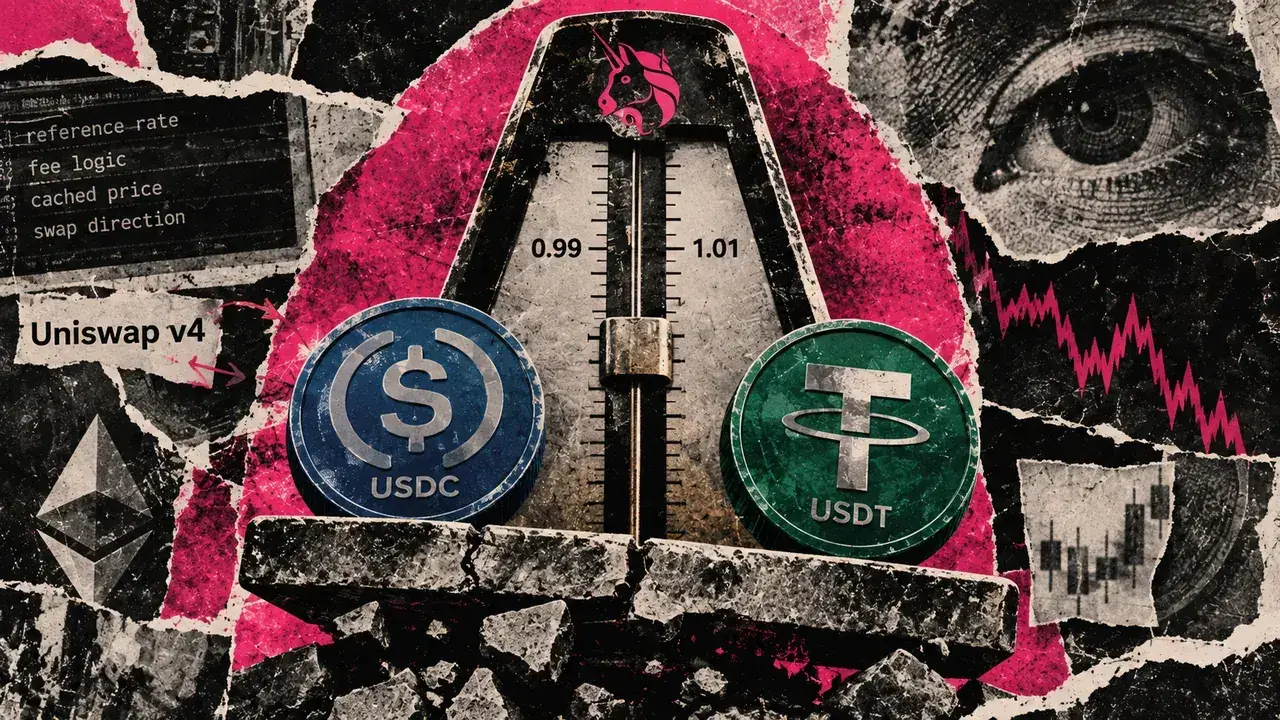
Uniswap’s StablePair fee hook is designed to keep more of the value from rebalancing stablecoin pools with liquidity providers.
Yet the rule deciding which trade counts as a correction depends on a configured reference rate.
StablePair is a Uniswap v4 hook, a contract that changes a pool’s behavior. Its fee logic compares a cached pool price with a reference stored in the hook’s configuration. The design prices trades around that benchmark, leaving providers exposed if a token’s economic value moves away.
Uniswap Labs announced the two Ethereum pools , USDC/USDT and USDC/USDG, on Sept. 10. Its Sept. 16 explanation noted that Providers allocating capital now are choosing a fee mechanism alongside the token inventory it requires them to hold.
The deployment documentation lists one-for-one reference rates for both pools. The implementation’s fee path uses that stored reference and the pool’s price, without consulting an external market-price feed.
Inside a narrow band around the reference, the fee varies by swap direction to target a consistent bid and ask before price impact. When the pool sits exactly at the reference, both directions pay the configured optimal fee. As it moves toward an edge, the fee in one direction falls while the other rises.
For a simple illustration, assume an optimal fee of one basis point (0.01%). At the reference, a swap with 10,000 input units would pay one input unit in LP fees.
Outside the band, the fee rules split trades by direction . A swap classified as moving farther from the reference pays zero LP fee, while a swap classified as pulling the pool toward it faces a decaying fee.
Crypto Profit & Yield Calculator
Simulate trading returns, staking APY, and crypto gains with real-time fee modeling.
Source: CryptoSlate.
Read the full story at the original source ↗
For questions: mrsmithcons@gmail.com.
💎 On-Chain Wallet Tracking & Breakout Targets
Direct wallet address monitoring, smart money flows, and liquidity depth.
⚡ Track Whale Wallets Now ➔More from CryptoAce VIP


 🪙 FreeFortune Crypto
Top Crypto Staking Platforms With Highest APY in 2026
Breaking coverage: Top Crypto Staking Platforms With Highest APY in 2026. Comprehensive monitoring, ongoing st...
 📈 FreeRich FIRE
Viele Amerikaner machen diese beiden Fehler bei der Altersvorsorge, sagt ein Top-Anlagestratege
Aktuelle Berichterstattung von Business Insider: Viele Amerikaner machen diese beiden Fehler bei der Altersvor...
 🚀 RocketCoin Casino
Best Bitcoin Casinos Ranked: Top 5 Highest-Paying Crypto Sites to Try in 2026
Breaking coverage reported by Sports Gambling Podcast: Best Bitcoin Casinos Ranked: Top 5 Highest-Paying Crypt...
 📈 1UpTrade Live
Ghana’s forex exchange and gold reserve strategy carries high fiscal cost – S&P Global
Breaking coverage reported by Ghana Business News: Ghana’s forex exchange and gold reserve strategy carries hi...