BTCPay Docker users must opt into Tor at their next update to keep onion access
Story summary
Existing installations must explicitly select Tor at their next setup or update, even though existing Tor data is preserved. The post BTCPay Docker users must opt into Tor at their next update to keep onion access appeared first on CryptoSlate.
📌 Key Highlights & Takeaways
- Existing installations must explicitly select Tor at their next setup or update, even though existing Tor data is preserved.
- The post BTCPay Docker users must opt into Tor at their next update to keep onion access appeared first on CryptoSlate.
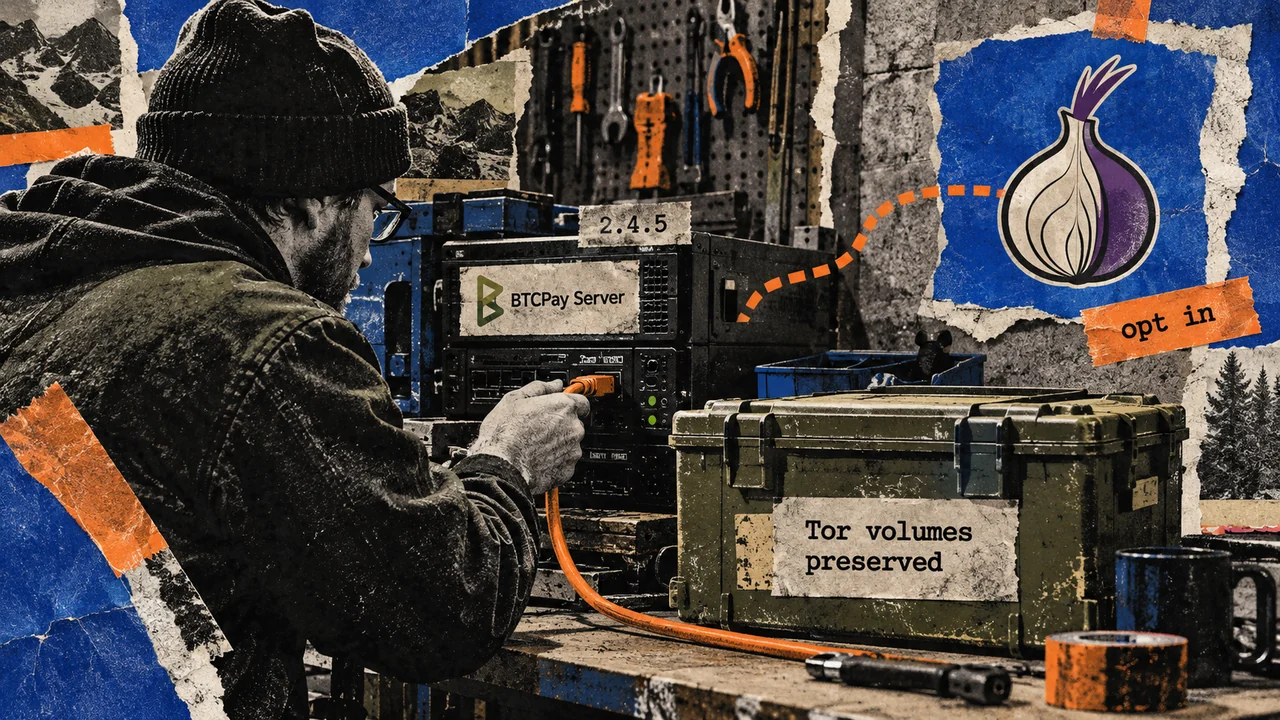
Operators running the Bitcoin payment software BTCPay Server through its standard Docker deployment must explicitly select Tor at their next setup or update if they want to retain onion access. The change removes Tor from the automatically included components, making a previously bundled service an administrator’s configuration choice.
BTCPay detailed the deployment change in its Oct. 5 announcement accompanying version 2.4.5. The official GitHub release page records the software release on Oct. 6. For existing installations, the relevant trigger is their next Docker setup or update.
The change matters to Docker operators who rely on Tor, including access through their server’s onion address, but previously received it through the core BTCPay Server fragment. Fragments are the configuration components used to assemble the Docker stack.
BTCPay advises administrators to review the deployment changes before updating. After updating to 2.4.5, its instruction for enabling Tor is:
sudo btcpay-fragments add opt-add-tor
Tor remains supported, and BTCPay says existing data stays in the current Tor volumes. That preserves stored data; continued onion access still depends on including and running Tor in the deployment.
BTCPay Server documentation describes the optional Tor fragment opt-add-tor as adding hidden services and selected onion connectivity. Operators can inspect configuration using btcpay-fragments show , which does not change configuration and reports saved additional and excluded fragments alongside the effective fragments from the last generated manifest.
Fragment-changing commands require root and reapply setup immediately.
From an on-chain analytics and liquidity distribution perspective, developments around "BTCPay Docker users must opt into Tor at their next update to keep onion access" signal important shifts in network participation. Market participants observe that derivative funding metrics, exchange reserve telemetry, and smart contract protocol interactions reflect cautious accumulation alongside disciplined risk hedging across the sector.
Technical research analysts at CryptoAce VIP note that high-density order book clusters and volume-weighted average price (VWAP) benchmarks near recent consolidation floors will serve as pivotal indicators. Market observers are advised to cross-examine telemetry on verified block explorers before making capital allocations.
Editorial Fact-Check & Verification Note: This briefing was curated, corroborated, and synthesized by the CryptoAce VIP Editorial Desk. Readers following "BTCPay Docker users must opt into Tor at their next update to keep onion access" are encouraged to review the full primary source coverage linked below for complete historical context, direct quotes, and official statements.
Crypto Profit & Yield Calculator
Simulate trading returns, staking APY, and crypto gains with real-time fee modeling.
Source: CryptoSlate.
Read the full story at the original source ↗
For questions: mrsmithcons@gmail.com.
❓ Frequently Asked Questions (Bitcoin Run Alpha Briefing)
What on-chain catalyst or market signal triggered this Bitcoin Run Alpha movement?
Institutional on-chain telemetry, cold storage accumulation, and derivative funding rates indicate spot liquidity positioning that underpins this Bitcoin Run Alpha development.
How should investors interpret current liquidity pools and network hash activity?
Derivative funding remains balanced and exchange reserves continue trending downward, mitigating systemic liquidation cascades and strengthening the underlying structural floor.
Where are the critical technical support and invalidation levels?
Anchored volume-weighted average price (VWAP) benchmarks and high-density order book clusters near prior consolidation ranges serve as key risk management thresholds.
💎 On-Chain Wallet Tracking & Breakout Targets
Direct wallet address monitoring, smart money flows, and liquidity depth.
⚡ Track Whale Wallets Now ➔More from CryptoAce VIP



 ₿ Lucky Satoshi
Bitcoin Life Insurer Meanwhile Raises $37.5M as Wealthy Families Look to Pass On Their BTC
Bitcoin Magazine Bitcoin Life Insurer Meanwhile Raises $37.5M as Wealthy Families Look to Pass On Their BTC Th...
 🚀 RocketCoin Casino
5 Best Bitcoin Casinos in 2026 – Top Crypto Gambling Sites Reviewed (New List This Week)
Breaking coverage reported by Sports Gambling Podcast: 5 Best Bitcoin Casinos in 2026 – Top Crypto Gambling Si...
 📈 1UpTrade Live
6 Best Forex Brokers by Swaps (Updated 2026)
Breaking coverage reported by FXLeaders: 6 Best Forex Brokers by Swaps (Updated 2026). Our news desk tracks on...
 ⚡ LiveCoin Bet
Precision Calculations: Betting Arbitrage & Surebet Calculator (Day 24 Guide)
Mathematical breakdown and formulas behind Betting Arbitrage & Surebet Calculator on LiveCoin Bet. Discover es...