Newer AI models missed more payment fraud in Coinbase’s benchmark
Story summary
A fixed historical replay found weaker fraud coverage across three model upgrades, while GPT’s precision improved. The post Newer AI models missed more payment fraud in Coinbase’s benchmark appeared first on CryptoSlate.
📌 Key Highlights & Takeaways
- A fixed historical replay found weaker fraud coverage across three model upgrades, while GPT’s precision improved.
- The post Newer AI models missed more payment fraud in Coinbase’s benchmark appeared first on CryptoSlate.
Coinbase reported Oct. 7 that newer versions of three major AI model families caught fewer fraudulent payments and a smaller share of fraud value in a historical test of payment screening for its Onramp service, despite an unchanged decision policy. The findings challenge the assumption that upgrading a model improves an existing payment screener.
The company’s evaluation replayed 16,140 transactions across 7,293 users, including 813 confirmed fraudulent transactions. The cohort covered nine weeks before its risk agent rolled out, retaining all matured fraud cases while sampling legitimate traffic.
Each candidate reviewed recent transaction behavior under fixed guidance and the same policy for turning risk classifications into decisions. This isolated the decision model’s behavior within that setup, rather than comparing redesigned screening systems.
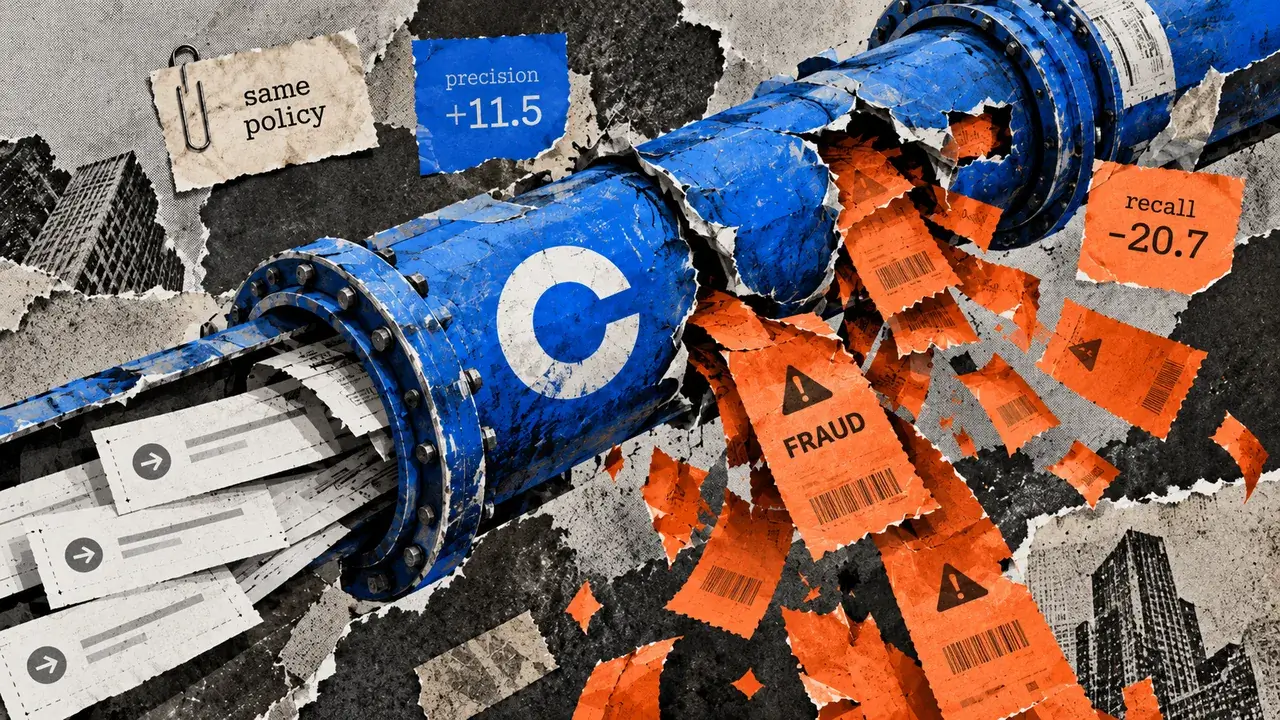
Coinbase compared Opus 4.5 with Opus 5, Sonnet 4.6 with Sonnet 5, and GPT-5.4 with GPT-5.6 (sol). Every newer version had lower recall, a lower combined precision-and-recall score called F1, and lower dollar-weighted recall. Recall measures the share of fraud cases a model catches; dollar-weighted recall measures how much of the total fraud value it catches.
Sonnet’s recall fell 22.2 percentage points and its dollar-weighted recall dropped 22.9 points. Opus’s recall declined 0.8 points. Both newer models also had lower precision, meaning a smaller share of transactions they classified as fraud were actually fraudulent.
GPT showed why one improving score can be misleading. Its precision rose 11.5 percentage points, but recall fell 20.7 points and dollar-weighted recall fell 21.8 points. Its fraud flags were more accurate, while more fraud cases and value escaped detection in the replay.
The replay does not establish customer losses from deploying those versions. Coinbase also said it could identify the regressions without establishing their cause.
Coinbase’s earlier online experiment compared adding selective LLM review with the existing models and rules alone. That agent-enabled flow recorded 30% fewer fraudulent transactions and 22% less fraud value; it did not compare newer model versions.
From an on-chain analytics and liquidity distribution perspective, developments around "Newer AI models missed more payment fraud in Coinbase’s benchmark" signal important shifts in network participation. Market participants observe that derivative funding metrics, exchange reserve telemetry, and smart contract protocol interactions reflect cautious accumulation alongside disciplined risk hedging across the sector.
Technical research analysts at CryptoAce VIP note that high-density order book clusters and volume-weighted average price (VWAP) benchmarks near recent consolidation floors will serve as pivotal indicators. Market observers are advised to cross-examine telemetry on verified block explorers before making capital allocations.
Editorial Fact-Check & Verification Note: This briefing was curated, corroborated, and synthesized by the CryptoAce VIP Editorial Desk. Readers following "Newer AI models missed more payment fraud in Coinbase’s benchmark" are encouraged to review the full primary source coverage linked below for complete historical context, direct quotes, and official statements.
Crypto Profit & Yield Calculator
Simulate trading returns, staking APY, and crypto gains with real-time fee modeling.
Source: CryptoSlate.
Read the full story at the original source ↗
For questions: mrsmithcons@gmail.com.
❓ Frequently Asked Questions (Whale Tracking Briefing)
What on-chain catalyst or market signal triggered this Whale Tracking movement?
Institutional on-chain telemetry, cold storage accumulation, and derivative funding rates indicate spot liquidity positioning that underpins this Whale Tracking development.
How should investors interpret current liquidity pools and network hash activity?
Derivative funding remains balanced and exchange reserves continue trending downward, mitigating systemic liquidation cascades and strengthening the underlying structural floor.
Where are the critical technical support and invalidation levels?
Anchored volume-weighted average price (VWAP) benchmarks and high-density order book clusters near prior consolidation ranges serve as key risk management thresholds.
💎 On-Chain Wallet Tracking & Breakout Targets
Direct wallet address monitoring, smart money flows, and liquidity depth.
⚡ Track Whale Wallets Now ➔More from CryptoAce VIP

 🪙 FreeFortune Crypto
Performance Benchmark: Loan Markup & Total Repayment Calculator (Day 7 Guide)
Understanding real-world data from the Loan Markup & Total Repayment Calculator on FreeFortune Crypto. Discove...
💎 Try2Rich
Performance Benchmark: Savings Goal & Milestone Target Calculator (Day 7 Guide)
Understanding real-world data from the Savings Goal & Milestone Target Calculator on Try2Rich. Discover essent...
💰 Free2Rich Online
Automation & Integration: Loan Markup & Total Repayment Calculator (Day 27 Guide)
Streamlining daily analytics with our Loan Markup & Total Repayment Calculator on Free2Rich Online. Discover e...
 📦 Free2Rich Vault
Decision-Making Framework: Loan Markup & Total Repayment Calculator (Day 28 Guide)
How data from our Loan Markup & Total Repayment Calculator on Free2Rich Vault. Discover essential eliminates b...