Some Aave loans sit near liquidation with collateral that can take hours to cash out
Story summary
October 9 borrower snapshots put the focus on whether collateral sales or redemptions can fund stablecoin repayment. The post Some Aave loans sit near liquidation with collateral that can take hours to cash out appeared first on CryptoSlate.
📌 Key Highlights & Takeaways
- October 9 borrower snapshots put the focus on whether collateral sales or redemptions can fund stablecoin repayment.
- The post Some Aave loans sit near liquidation with collateral that can take hours to cash out appeared first on CryptoSlate.
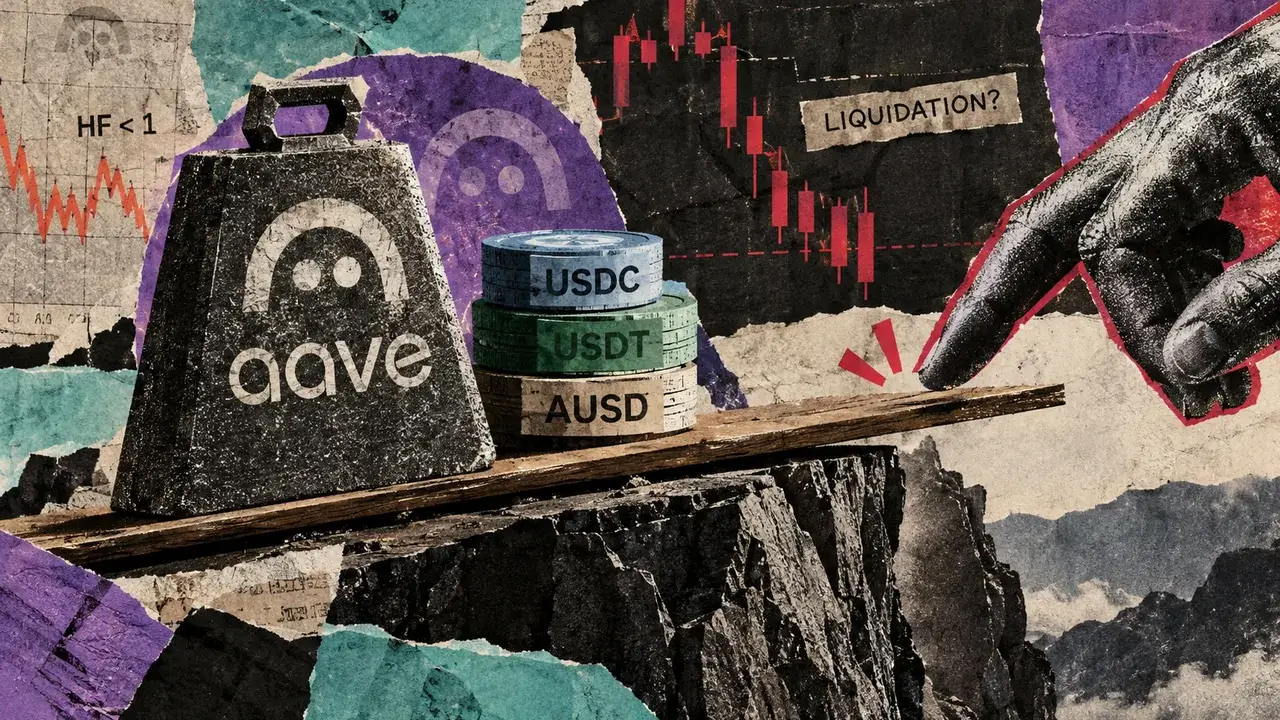
Some Aave loans backed by yield-bearing collateral had narrow liquidation buffers in LlamaRisk’s Oct. 9 snapshots. Every top PT-AUSD supplier on Monad carried debt, while two syrupUSDC positions accounted for about 97% of supplied syrupUSDC on Arc. Cashing out the collateral involves a market sale or, for Arc holders choosing Ethereum redemption, a withdrawal queue that can take hours.
The two markets present separate versions of the same cash-flow problem. If a borrower becomes eligible for liquidation , a liquidator supplies the borrowed stablecoin, receives collateral and then recovers cash from it. December PT-AUSD requires a sale before maturity. Arc syrupUSDC offers a local sale or a bridge to Ethereum for redemption. An oracle valuation establishes collateral value within Aave; the exit determines what the liquidator can recover.
The Oct. 9 reviews of Monad and Arc recommend larger caps, making the economics of those exits consequential as borrowers seek room to grow.
Aave’s health factor compares collateral value, adjusted for liquidation thresholds, with debt. A position becomes eligible for liquidation below 1. The top Monad PT suppliers had health factors between 1.01 and 1.18, with a median of 1.03, in the Oct. 9 snapshot. USDC was their dominant debt asset, followed by USDT0.
Those readings leave a narrow valuation cushion for part of the cohort. They also reflect why borrowers pair correlated collateral and debt: smaller relative price changes can support higher leverage. Aave notes that lower health factors may be appropriate for correlated assets.
During liquidation, someone repays the borrower’s debt and receives collateral plus an incentive. The liquidator weighs the collateral’s realizable proceeds against the debt repaid, transaction and conversion costs, and the cost of financing any redemption wait. The health factor measures proximity to eligibility; a sale quote measures the exit.
The Monad collateral is PT-AUSD-17DEC2026, a Pendle principal token representing a claim on AUSD at its Dec. 17 maturity. The redemption entitlement is in the accounting asset. Receiving one AUSD still requires any conversion needed to obtain the USDC or USDT0 borrowed against it.
LlamaRisk reported that the reserve’s 30 million PT supply cap was fully utilized on Oct. 9 and recommended increasing it to 60 million PT. These limits measure token capacity. A larger cap would allow more collateral into Aave; its successful exit would still depend on buyers or redemption.
Crypto Profit & Yield Calculator
Simulate trading returns, staking APY, and crypto gains with real-time fee modeling.
Source: CryptoSlate.
Read the full story at the original source ↗
For questions: mrsmithcons@gmail.com.
❓ Frequently Asked Questions (DeFi High-Yield Briefing)
What on-chain catalyst or market signal triggered this DeFi High-Yield movement?
Institutional on-chain telemetry, cold storage accumulation, and derivative funding rates indicate spot liquidity positioning that underpins this DeFi High-Yield development.
How should investors interpret current liquidity pools and network hash activity?
Derivative funding remains balanced and exchange reserves continue trending downward, mitigating systemic liquidation cascades and strengthening the underlying structural floor.
Where are the critical technical support and invalidation levels?
Anchored volume-weighted average price (VWAP) benchmarks and high-density order book clusters near prior consolidation ranges serve as key risk management thresholds.
💎 On-Chain Wallet Tracking & Breakout Targets
Direct wallet address monitoring, smart money flows, and liquidity depth.
⚡ Track Whale Wallets Now ➔More from CryptoAce VIP



 📈 1UpTrade Live
Support for the US Dollar Remains Solid: Focus on Near-Term Risks and High-Conviction FX Trading Strategies
Breaking coverage reported by 富途牛牛: Support for the US Dollar Remains Solid: Focus on Near-Term Risks and High...
 📈 FreeRich FIRE
Is FIRE right for you? What early retirement really takes
Breaking coverage reported by Black Hills Pioneer: Is FIRE right for you? What early retirement really takes. ...
 💵 GetRichFree Store
Citi Offers: Walmart.com, Spend $75 & Get $5 Back
Check your Citi Offers for the following deal: Get 10% back on Walmart.com and the Walmart mobile app, up to $...
 🎰 WinBar VIP
Brandon Wilson Wins $100K Super High Roller Bowl for $1.1M After Nearly Bubbling
Wilson defeated recent Triton $150K Anniversary champion Nick Petrangelo....